
Google DeepMind and Google Research have released WeatherNext 3, a new AI model for weather forecasting. Spatial resolution now reaches 5 km for key variables, and forecasts refresh hourly instead of every 6 hours. The model will progressively feed the weather information shown in Google Search, Google Maps, and Gemini, and it is also available to researchers and developers through Google's cloud platforms.
Targeting the weak spots of AI forecasting
Deep learning has moved into practical territory in meteorology over the past few years, but its shortcomings have been well documented. AI forecasts typically covered areas of 15 to 25 square km, which is too coarse for everyday decisions. Rainfall prediction remained weak. And the models still depended on formatted datasets prepared by government weather agencies.
WeatherNext 3 goes after all 3 problems at once. Resolution drops to 5 km for key variables, rainfall evaluations improve by 60 percent over WeatherNext 2, and the model produces hourly forecasts rather than the standard 6-hour cadence.
Those gains come from scaling the model and reworking what it is asked to output. WeatherNext 3 carries 2.4 times more parameters than its predecessor, and the targets assigned to its decoder heads were tuned so the answers are actually usable. DeepMind researchers had already drawn attention for shaping their model to visualize cyclone tracks rather than simply averaging values across a grid. This time they went further and trained the model to forecast for specific weather observation stations.
Why station-level forecasting matters
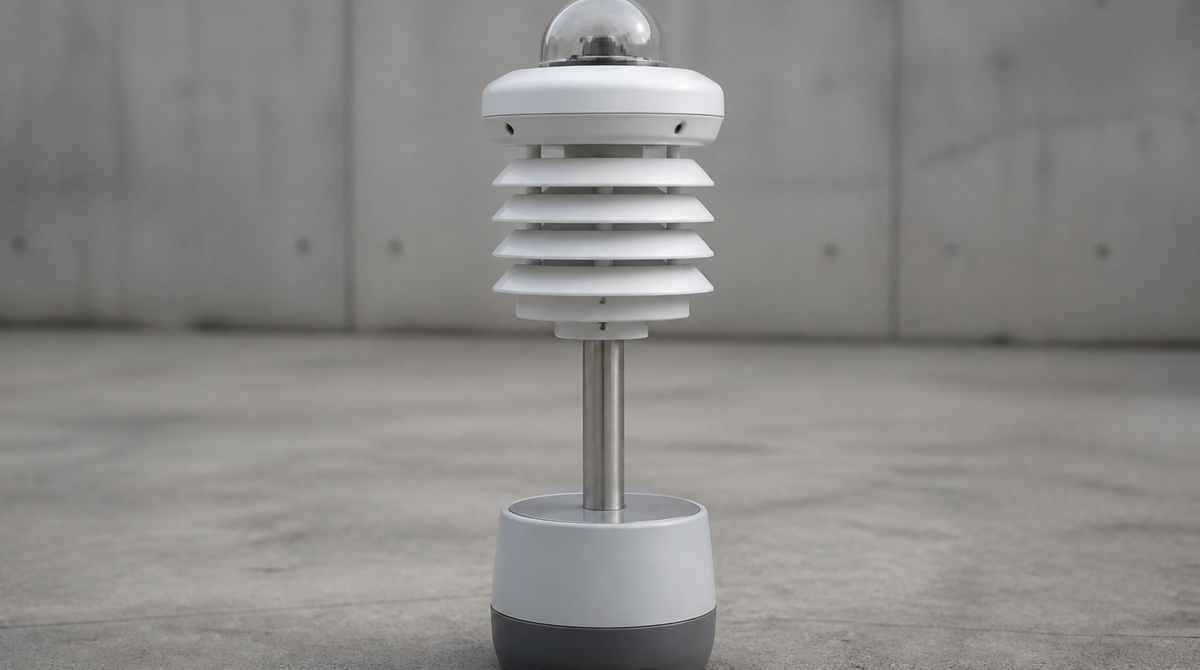
Predicting at the station level is not just about finer detail. It also lets a forecast be checked directly against ground-truth measurements from that exact location.
If the model predicts what a given airport's weather station will record an hour from now, the forecasting task moves closer to the measurement it is supposed to describe. Running a process end to end is a familiar principle across AI applications, and it has now arrived in weather prediction.
Ingesting raw satellite observations
The higher update frequency is possible because the model can take in weather satellite data collected in real time on an hourly basis.
Earlier AI forecasting models were fed the analysis products generated by government supercomputers solving physics equations. That data is convenient, but it is already one step removed from raw observation. Working directly from unprocessed measurements should in theory improve accuracy, yet feeding unformatted data into a model has long been a technical barrier.
Google describes WeatherNext 3 as the first AI model to directly incorporate raw observations for a high-resolution global forecast. That claim is disputed. WindBorne, an AI weather startup, says its WeatherMesh 6 has been taking raw data from its fleet of weather balloons and other sources since late 2025. Google responded that its own forecasts are higher resolution across the globe. Either way, both models still rely on national weather datasets to produce forecasts, so full direct data assimilation remains some distance away.
Beating physics-based forecasts on the benchmark
Accuracy comparisons use Operational WeatherBench, a utility built by the startup Brightband that lines up multiple models on metrics such as temperature, wind speed, and humidity. WeatherNext 3 took the top position there.
The field included Google's own earlier models along with deep learning models from Microsoft, NVIDIA, and the European Centre for Medium-Range Weather Forecasts (ECMWF). It also outperformed the conventional physics-based forecasts issued by the U.S. National Weather Service and the ECMWF.
The field opened up in 2018, when the ECMWF published more than half a century of weather data. Forecasts from government supercomputers are highly accurate but expensive and comparatively slow. Once deep learning models trained on that released data began matching their accuracy in a fraction of the time, meteorology went through its own transformer moment, separate from the one in language models. Weather is chaotic, and small differences amplify quickly. Approximating noisy physics from incomplete information and finite compute happens to be a problem shape that machine learning handles well.
From search results to agriculture and renewables
For Google, this release is both a research result and a product deployment. It is the first time core variables from the model will directly power Google products, replacing the foundation behind the weather information returned by Search, Maps, and Gemini.
The applications go beyond consumers. AI forecasting is promising for regions that cannot afford high-quality sensors and supercomputers, because it can deliver accurate predictions cheaply. Bill Gates has pointed to AI-powered weather forecasting as a way to raise crop yields in developing countries. DeepMind researchers add that high-resolution forecasts of wind, rain, and cloud cover would make renewable energy projects more dependable.
Summary
WeatherNext 3 raises the practical value of AI weather forecasting on 3 fronts: 5 km resolution, hourly updates, and direct use of raw satellite observations. On the benchmark it outperformed not only rival AI models but also conventional physics-based forecasts. Full assimilation of raw data is still unfinished work, but with the model wired into Search and Maps, improvements in AI forecasting now translate directly into everyday usefulness.