
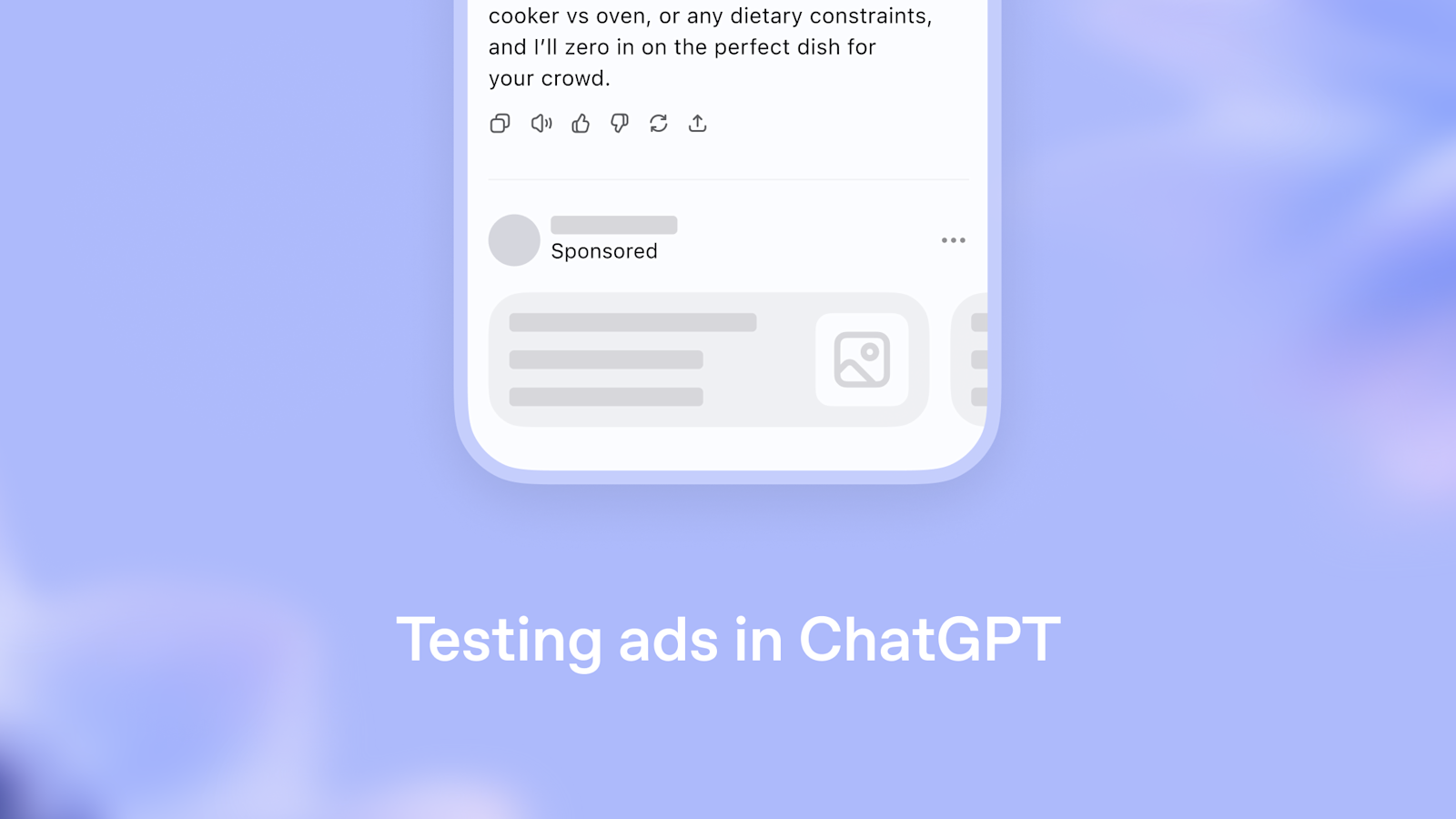
On August 11, OpenAI announced that ChatGPT Ads has launched in the United Kingdom, Mexico, Brazil, Japan, and South Korea[1]. What began in February 2026 as a limited test for some users in the U.S. has reached major markets in roughly 6 months. In Japan, ads had already started appearing in June, so this update marks the point where the pilot expansion is largely complete.
From test to launch in 6 months
Ads in ChatGPT started in the U.S. on February 9, 2026[1]. They were shown only to logged-in adults, and only on the Free and ChatGPT Go tiers. Plus, Pro, Business, Enterprise, and Education plans have been ad-free from the beginning, and that line has not moved[1].
In a March 26 update, OpenAI described early results as encouraging, citing no impact on consumer trust metrics, low dismissal rates for ads, and steadily improving ad relevance[1]. That prompted expansion to Canada, Australia, and New Zealand, and on May 7 the company named the next 5 markets: the United Kingdom, Mexico, Brazil, Japan, and South Korea[1].
The August 11 update confirms that all 5 are now live[1]. Notebookcheck reported that as of August 6, the Ads Manager availability page in the OpenAI Help Center listed Australia, Canada, Japan, Korea, New Zealand, the United Kingdom, and the United States as available, with Brazil and Mexico still marked Coming Soon[3]. Those 2 markets filled in within about 5 days. Germany does not appear on that list at all[3].
Japan started on June 19, with Dentsu Digital and Hakuhodo DY ONE as launch partners
Ads actually began showing in Japan on June 19[2]. As in the U.S., the audience is logged-in adult users on the Free or ChatGPT Go tier[2].
For the Japanese market, Dentsu Digital and Hakuhodo DY ONE announced that they had begun handling ChatGPT ads as launch partners for the pilot[2]. For domestic advertisers, that means ChatGPT inventory is now reachable through the agencies they already work with.
Ads sit below the answer, always labeled sponsored
The presentation is deliberately restrained. Ads appear below the response, are always marked as sponsored, and are visually separated from the organic answer[1][2]. OpenAI repeatedly states that ads do not influence ChatGPT's answers, and that they run on systems separate from the chat model[1][3].
Which ad appears is decided by matching advertiser submissions against the topic of the conversation, past chats, and past interactions with ads[1][2]. If you are researching recipes, you may see meal kit or grocery delivery ads[1]. When multiple advertisers qualify, the one most relevant to the chat is shown first[1].
There are also places ads will not go. Accounts that state they belong to someone under 18, or that OpenAI predicts belong to a minor, do not receive ads[1][2]. Ads are not eligible near sensitive or regulated topics such as physical health, mental health, and politics, and political advertising is not permitted in ChatGPT at all right now[1][3]. Temporary chats show no ads either[3].
Advertisers only see aggregate numbers
The privacy design is spelled out directly in the announcement. Advertisers cannot access your chats, chat history, memories, or personal details[1][2]. What they receive is aggregate performance data such as views and clicks[1][2]. Name, email address, precise location, and IP address also stay out of their reach[3]. The one exception is that if you message an advertiser directly through an ad, that advertiser sees those messages[3].
Users get a full set of controls: dismissing ads, sending feedback, checking how and why a particular ad was shown, deleting ad data with one tap, and managing ad personalization[1][2]. Deleted ad data can take up to 30 days to disappear from OpenAI's servers[3].
One point is easy to misread. Turning off personalization does not remove ads[3]. It only narrows the material used to pick them down to your current chat thread. Leave it on, and past chats, saved memories, and your own behavior toward ads feed in as well[3].
To remove ads, pay up or give up usage
There are 3 ways to avoid ads. The first is a paid plan: Plus (20 USD, about 3,200 yen) or Pro (100 USD, about 16,000 yen) removes ads entirely[2].
※1 USD = 159 JPY (as of August 11, 2026)
The second is opting out while staying on the Free plan, which costs you daily message capacity instead[1][2]. According to Notebookcheck, you can go ad-free at no charge through Settings, then Ads controls, then change plan, but your message limit drops and some tools become unavailable, specifically image generation and deep research[3]. The third route is the temporary chat, which never shows ads[3].
There is no option that combines free access, no ads, and unchanged usage limits. Accept the ads, pay, or use less. That is the choice this rollout has settled into.
Rivals are using this as an angle
Advertising is also an opening for competitors. Anthropic has stated that its assistant Claude will not carry ads in conversations, and it has run advertising of its own built around that position[3].
OpenAI's argument has stayed consistent. Keeping the Free and Go tiers fast and reliable requires significant infrastructure and ongoing investment, ads help fund that work, and the result is broader access to AI[1]. The company also argues that in a conversational interface, where people are actively comparing options or working toward a decision, ads can be more relevant and more useful than in traditional formats[1].
The question of how you pay for something that is free is not new. Conversational AI is simply walking a road search engines took 20 years to travel, at a much faster pace.
Summary
On August 11, OpenAI announced that ChatGPT Ads had launched in the United Kingdom, Mexico, Brazil, Japan, and South Korea. Ads began appearing in Japan on June 19, with Dentsu Digital and Hakuhodo DY ONE serving as launch partners. Only logged-in adults on the Free and ChatGPT Go tiers see ads; paid plans from Plus upward remain ad-free. Advertisers receive only aggregate figures such as views and clicks, with no access to chat content or personal details. Removing ads means moving to a paid plan, opting out on Free in exchange for reduced usage, or using temporary chats.
Source[1]: https://openai.com/index/testing-ads-in-chatgpt
Source[2]: https://www.watch.impress.co.jp/docs/news/2118443.html