
On July 23, 2026 (U.S. time), Google began rolling out a set of updates covering its Gemini for Home voice assistant, the Google Home mobile app, and firmware for Nest cameras. Two changes stand out: the assistant now holds conversational context for 15 minutes, and Gemini Live is arriving on the first-generation Google Home Mini and Nest Hub. None of it is flashy, but together it sharpens the day-to-day experience.
Follow-up questions now remembered for 15 minutes
Start with the voice assistant. The conversational memory across the entire Gemini for Home experience now stretches to 15 minutes, so a follow-up said a little later still carries the earlier context.
For example, ask "Hey Google, turn on the kitchen lights," and a few minutes later simply say "dim it to 50%." Gemini understands you are still talking about those lights and adjusts them. You no longer have to explain the situation from scratch every time, and conversations flow more naturally even with a smart speaker. Gemini on phones and PCs could already retain context, but that continuity tended to break on smart home devices. This update closes that gap.
Gemini Live comes to first-gen speakers
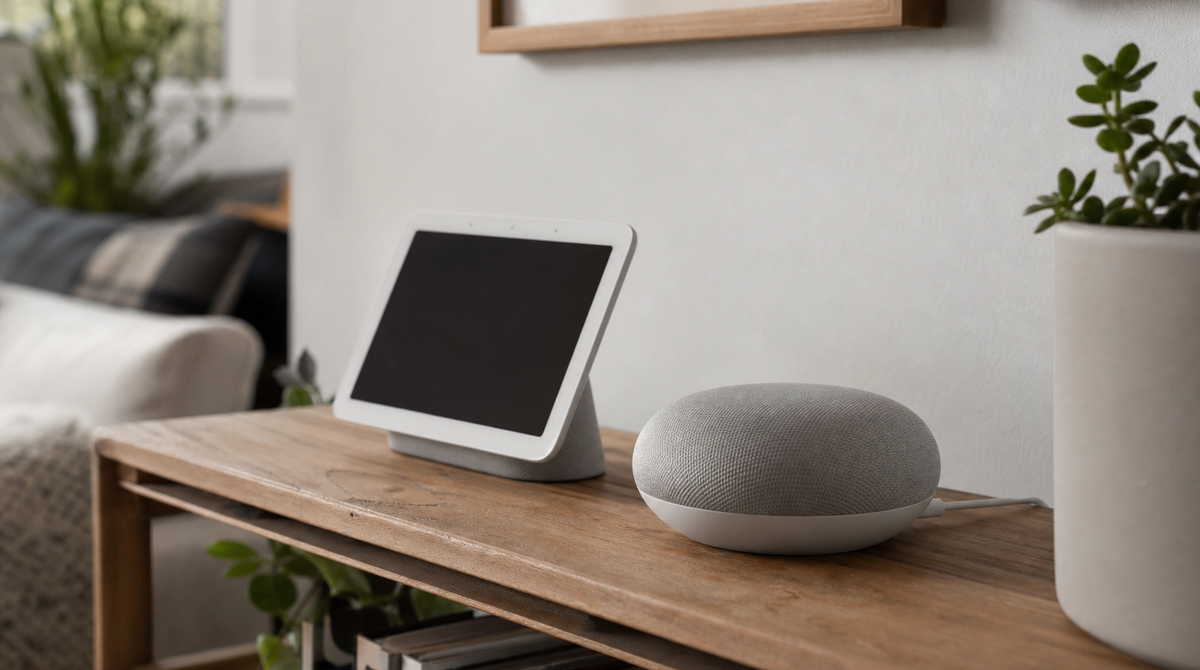
The other pillar is Gemini Live support for the first-generation Google Home Mini and Nest Hub. Say "Hey Google, let's chat," and a fluid, back-and-forth conversation begins with little delay.
Until now, Gemini Live worked on the Nest Mini, Nest Audio, Nest Hub, Nest Hub Max, and the newest Google Home Speaker. These older, first-generation models now join that group. There is a catch: using Gemini Live on the older speakers requires a paid Google Home Premium subscription, and it is rolling out gradually, starting through an early access sign-up. It is welcome to see aging speakers grow smarter while staying in service, but getting the full conversational experience carries an added cost, so reactions may be mixed.
App gains automation and smart lock refinements
The Google Home mobile app also moves to version 4.22 with several usability tweaks. In automations, trying to save a routine that has conditions but no starter (trigger) now shows an alert, helping prevent automations that quietly fail to run. Controls and labels for smart blinds and window coverings were also revised, making it easier to set precise shade positions.
For smart locks, a new reminder notes that when you remove a member or leave a home, that user's passcodes need to be changed or removed manually. Beyond that, the update reduces video playback errors on iOS and brings live feeds closer to real time, and it fixes issues where video failed to resume after unlocking your phone, where deep links did not open the intended screen, and where a fully charged camera battery was wrongly reported as having zero hours left.
New firmware for Nest cameras
Google is also gradually pushing a July 2026 software update to select Nest cameras: the Nest Cam Indoor (wired, 3rd gen), Nest Cam Outdoor (wired, 2nd gen), and Nest Doorbell (wired, 3rd gen).
Connectivity becomes more stable with fewer unexpected drops or crashes, and setup runs faster and more reliably when adding new cameras. A bug that triggered person and familiar-face alerts inside zones set to be ignored has been fixed. The update also resolves cases where the app would freeze, show an incorrect camera online status, or fail to apply changed camera settings.
Summary
This Gemini for Home update is less about headline features and more about steadily raising the quality of everyday use. The 15-minute memory cuts down on repeated instructions, and veteran speakers like the first-gen Home Mini and Nest Hub can now converse through Gemini Live. Combined with the smaller refinements to the app and Nest cameras, the whole smart home experience feels smoother. Extending the useful life of older hardware through a software update is a positive, though the fact that part of the conversational feature sits behind a paid plan is worth keeping in mind before you dive in.