
At its GTC Taipei keynote in Taiwan, NVIDIA announced that Vera Rubin, a platform pairing a new CPU and GPU for AI data centers, has entered full production. Alongside it, the company unveiled the NVIDIA DSX AI Factory Platform, which packages the design of an entire AI data center. By stepping beyond servers and racks to the level of a whole facility, NVIDIA is signaling an ambition to change how AI infrastructure itself is built.
What Vera Rubin Is
The announcement came during a keynote delivered by CEO Jensen Huang at the Taipei Music Center. In recent years NVIDIA has repeatedly used its Taipei talks tied to COMPUTEX to make major data center AI announcements, and this year followed the same pattern.
Vera Rubin is a platform first unveiled at Computex 2024 that combines the next-generation "Vera" CPU and "Rubin" GPU for AI factories, meaning data centers built specifically for AI processing. Huang revealed that full production of Vera Rubin has started, adding that preparations for shipment are proceeding on schedule. A product moving into mass production marks a milestone that shipments to data centers around the world are drawing near.
The Vera CPU, Built Around Low Latency
The part of the talk Huang spent the most time on was the in-house "Vera" CPU.
Traditional CPUs have evolved by adding more cores to handle tasks in parallel. Vera, by contrast, is designed with an emphasis on low latency, meaning short waiting time in the exchange of data. It is built on NVIDIA's own "Olympus Core," and Huang stressed that this design is optimal for AI inference, the stage where a trained AI actually produces answers.
He illustrated the advantage with performance comparisons. Compared with x86 processors, SQL database operations run about 3 times faster, and processing of real-time streaming data runs about 6 times faster. The logic is that as AI agents that move autonomously back and forth between CPU and GPU become more common, the value of such a low-latency design becomes more pronounced.
DSX, Designing an Entire Data Center
The other headline was the NVIDIA DSX AI Factory Platform.
AI factories now being built around the world are a new type of data center specialized for AI training and inference, and they require designs quite different from conventional ones. Depending on scale, they can draw gigawatt-class power, demanding 800V DC power delivery as well as stable supply backed by batteries and capacitors. Because they assume liquid cooling for thermal design, they also require careful work on plumbing and water systems.
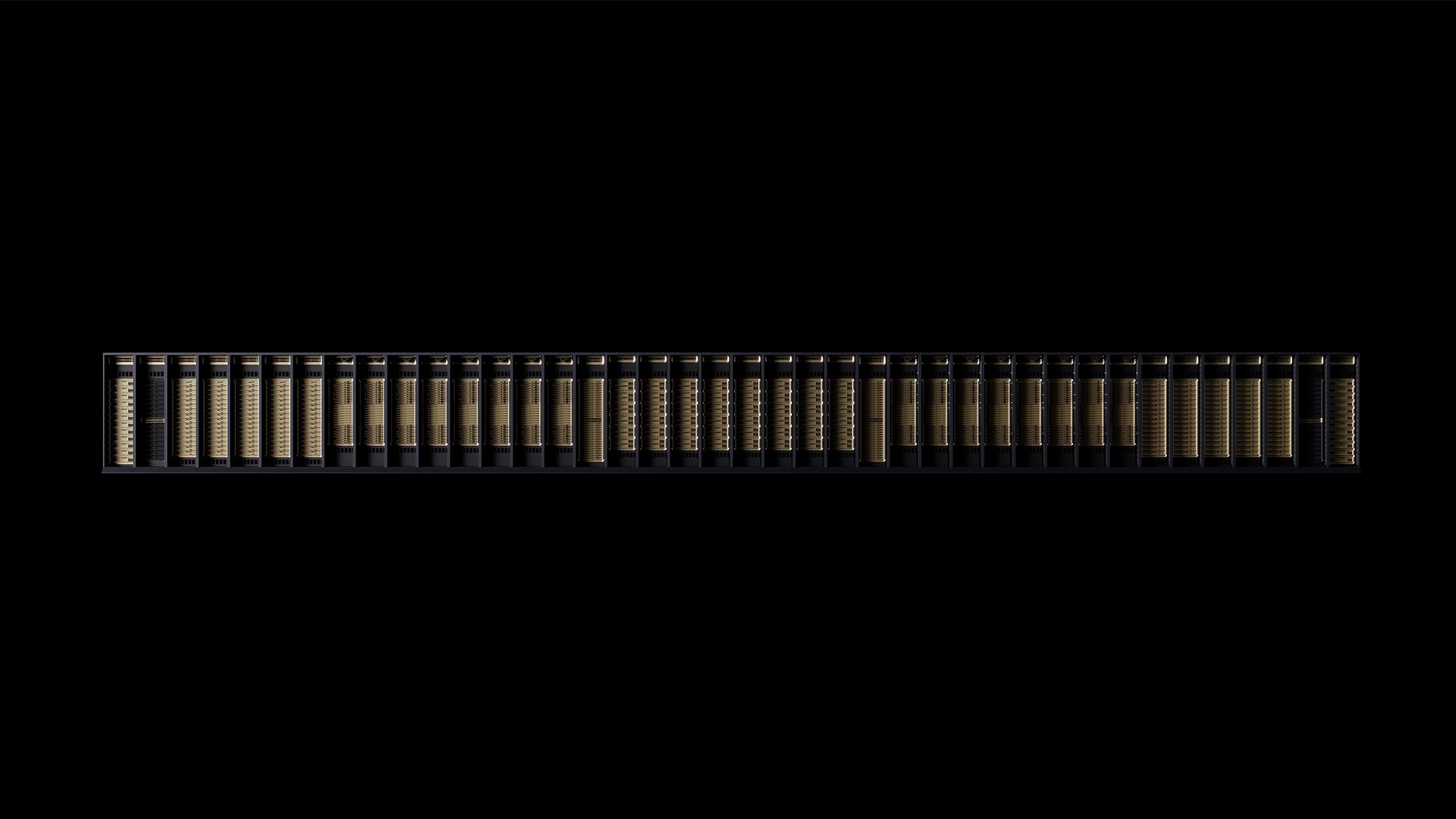
DSX is a framework that bundles together this know-how, from AI factory design methods to how to source the necessary materials. NVIDIA has steadily widened its scope, starting with the "DGX" server, moving to rack-level designs such as "GB200/300 NVL72" and "Vera Rubin NVL72" (a configuration bundling 72 Rubin GPUs and 36 Vera CPUs), and now with DSX reaching the design of the data center itself.
A Supply Chain Anchored in Taiwan
According to NVIDIA, makers including Dell Technologies, HPE, Lenovo, Supermicro, ASUS, Foxconn, GIGABYTE, Pegatron, Quanta Cloud Technology (QCT), Wistron and Wiwynn plan to adopt DSX and Vera Rubin to deliver AI factories to their customers. The lineup consists of leading server manufacturers centered on Taiwan, underscoring the depth of the supply chain that will turn NVIDIA's new platform into actual hardware.
The venue itself is significant. On the same Taipei stage last year, NVIDIA announced "NVLink Fusion," a technology for linking different chips over NVLink, which later led to a partnership with Intel. The pattern of data center AI milestones being unveiled in Taipei has continued this year as well.
Summary
NVIDIA announced the start of mass production for the CPU-and-GPU Vera Rubin, along with the DSX AI Factory Platform for designing an entire data center. With three elements in place—the Vera CPU optimized for AI inference, whole-facility design know-how, and a supply chain centered on Taiwanese firms—a system is taking shape to deliver AI infrastructure not as parts but as a complete package. How much this move, aimed at the spread of AI agents, will accelerate future data center construction is worth watching.