NVIDIA says its next-generation AI infrastructure, the Rubin platform, is the first in the industry to achieve 100 percent liquid cooling, with every component in the system cooled by liquid alone[1]. The defining trait is a design that deliberately raises the coolant temperature to 45°C, hotter than a hot tub, and that higher temperature is precisely what unlocks energy savings. The goal is to sharply cut the electricity and water that data centers consume, making it a notable efficiency play as AI compute demand keeps climbing.
Rethinking Cooling by Raising the Coolant to 45°C
A hot tub sits at about 38 to 40°C, warm enough that most people can only soak for around 15 minutes. NVIDIA's newest AI servers can run their coolant even hotter, up to 45°C (113°F)[1]. It may sound counterproductive, but that higher temperature ceiling is exactly what makes the system more energy efficient.
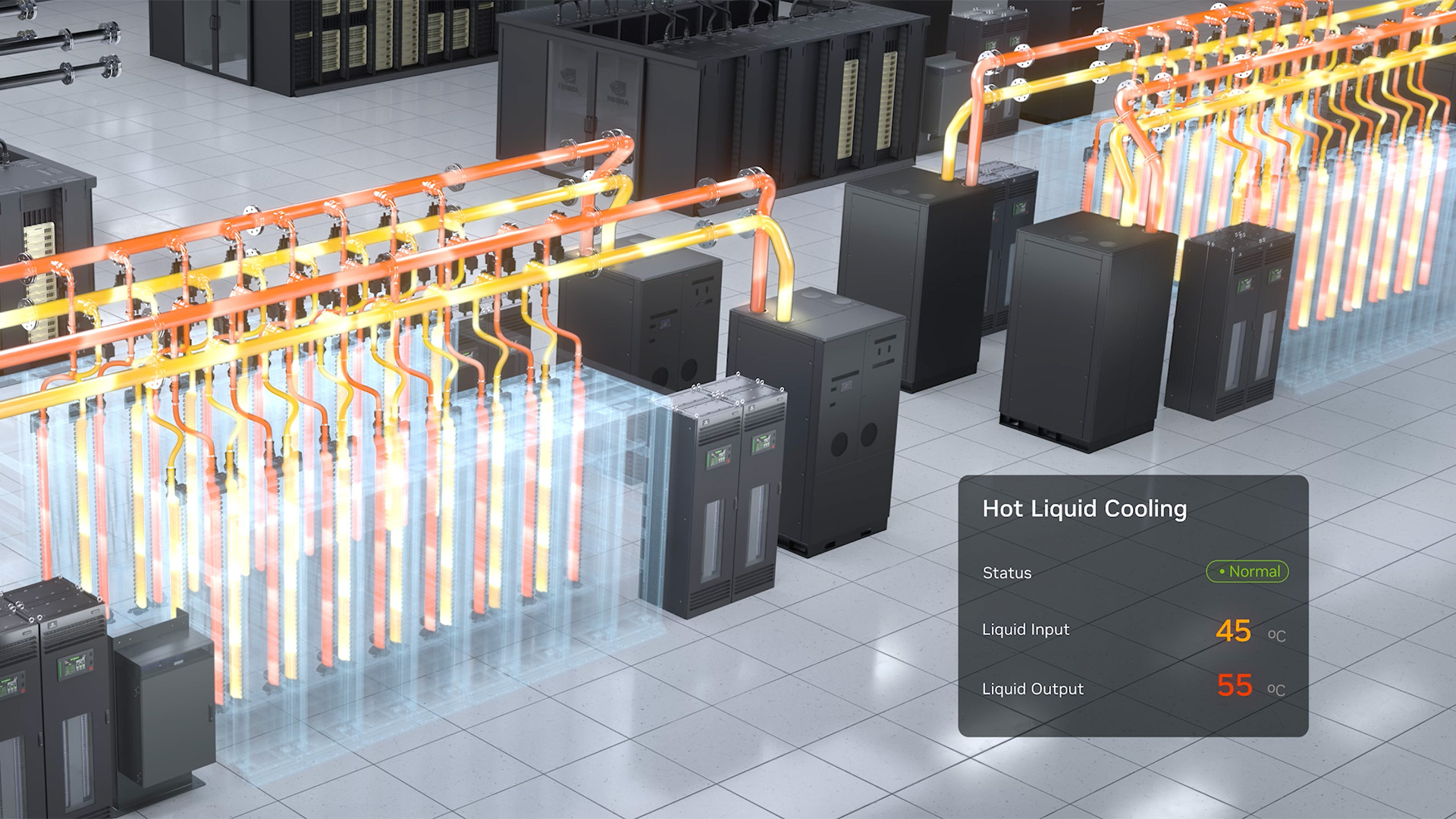
There is a long-standing assumption in the cooling world that a colder data center is a more efficient one. Decades ago, if a facility did not feel like a walk-in freezer, people assumed something was wrong[1]. In reality, silicon processors can run reliably in far warmer environments than that instinct suggests. Coolant that enters a fully liquid-cooled chip at 45°C exits at roughly 55°C after absorbing the heat, yet performance does not degrade, because the cold plates that sit directly on each chip keep device temperatures within validated operating limits[1].
Energy Savings and Zero Water Use Through 100% Liquid Cooling
In the Rubin generation, every chip and networking component is cooled by liquid in a closed loop with no fans anywhere in the system[1]. The approach is laid out in the NVIDIA DSX reference design, a guide covering how to design, build, and operate an entire AI factory.
The payoff shows up in the numbers. Cooling has historically accounted for up to 40 percent of a data center's electricity consumption, making it one of the areas with the most room for improvement[1]. Industry estimates suggest that raising chiller plant temperatures by just one degree can cut cooling energy costs by about 4 percent. At scale the savings add up quickly: a 50-megawatt hyperscale facility can save over 4 million USD (about 640 million yen) a year in cooling-related energy and water costs by moving to liquid-cooled infrastructure※1 USD = 161 JPY (as of June 22, 2026).
Water use changes even more dramatically. In favorable climates, pairing 45°C liquid cooling with dry coolers (outdoor heat-rejection units) enables chiller-less operation, cutting water consumption from roughly 2.6 million gallons per megawatt per year under conventional cooling-tower systems to near zero[1]. Ali Heydari, director of data center cooling and infrastructure at NVIDIA, says the DSX reference design has zero water consumption, eliminating massive amounts of power use and nearly all water use[1].
A Fundamentally Different Machine: No Fans, No Cold Aisles
Walk into a traditional data center and two things stand out. One is the noise: cooling fans push total sound to 85 decibels or more, loud enough to require ear protection[1]. The other is the carefully managed layout of hot aisles and cold aisles used to drive cooled air across components.
The Rubin architecture upends that picture. The coolant, a mix of 75 percent water and 25 percent propylene glycol, flows through cold plates placed directly on the processors, pulling heat out at the source[1]. Running that liquid at up to 45°C means that in many climates the facility loop can reject heat without mechanical chillers or noisy fans. There is also potential for waste heat recovery, where residual heat from AI factory operations could be repurposed to warm nearby commercial or residential buildings[1].
A Ground-Up Redesign to Clear the Engineering Hurdle
Earlier liquid-cooled servers were hybrids: GPUs and CPUs got cold plates while the rest of the system stayed air-cooled[1]. Making a fully liquid-cooled server meant rethinking how those remaining components shed heat. NVIDIA's thermal engineering team designed loops that route coolant to multiple high-power chips on the board through a single inlet and outlet, producing a cleaner tray-level cooling architecture[1].
The result is visible too. Where air-cooled servers have perforated front bezels for airflow, Rubin servers have clean, sealed front panels[1]. Rack density also rises: a system that once occupied six rack units now fits in two. Richard Whitmore, president and CEO of Motivair, the advanced cooling division of Schneider Electric, says that once the watts per chip crossed a certain level, liquid cooling became mandatory[1]. That said, how far chiller-less operation can go depends heavily on local climate, and a site with reliably cool outdoor air faces very different realities from one in a hot region.
Summary
With the Rubin generation, NVIDIA has become the first in the industry to cool an entire system with liquid alone and no fans. By running coolant at up to 45°C, the design curbs cooling electricity while bringing water use close to zero in favorable climates. A 50-megawatt facility could save more than 4 million USD a year, positioning the technology as one of the more important tools for holding down the energy load as AI compute demand keeps growing.
Source: https://blogs.nvidia.com/blog/liquid-cooling-ai-factories/