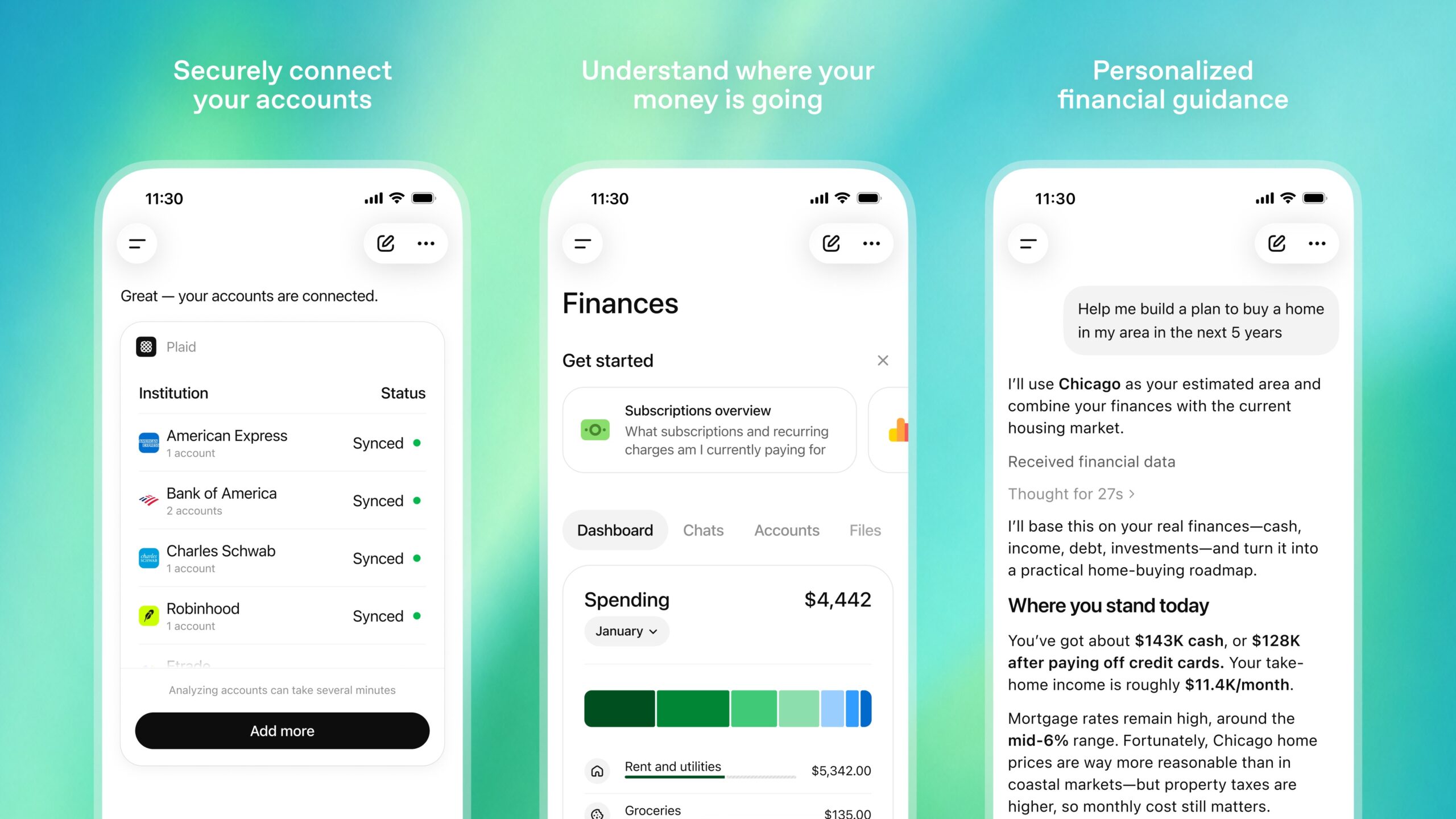
On May 15, 2026 (US time), OpenAI rolled out a preview of a new "Personal finance" experience in ChatGPT, allowing U.S. ChatGPT Pro users to link their bank accounts and credit cards and ask questions grounded in their own financial data[1][2]. The feature works on the web and on iOS, and connects to more than 12,000 financial institutions through Plaid[2][3]. OpenAI notes that over 200 million people already ask ChatGPT financial questions every month, and the launch pairs a dedicated dashboard with the stronger contextual reasoning of GPT-5.5[2].
Starting from the "Finances" sidebar, with a dashboard for spending and assets
The preview requires a ChatGPT Pro subscription with a U.S. account. Users can begin by selecting "Get started" inside the "Finances" entry in the sidebar, or by typing "@Finances, connect my accounts" from any conversation[2][4]. After Plaid-based authentication, ChatGPT spends a few minutes ingesting and categorizing the connected transactions[4].
Once set up, the dashboard surfaces spending, subscriptions, upcoming payments, and portfolio performance, alongside high-level views such as monthly spending charts and the asset-class breakdown of the user's investments[2][3]. Users can also feed ChatGPT additional context like financial goals so that future answers are grounded in those targets[4].
Plaid links 12,000+ institutions, with clear limits on what ChatGPT can see
Account connections are handled through Plaid, covering more than 12,000 institutions[2]. OpenAI and TechCrunch cite Schwab, Fidelity, Chase, Robinhood, American Express, and Capital One as representative examples[2]. Intuit support is described as coming soon, opening the door to analysis like the tax impact of selling a position, or the odds of being approved for a new credit card[2].
What ChatGPT can read is intentionally narrow: balances, transactions, investments, and liabilities, with no access to full account numbers and no ability to move money[3]. Users can disconnect individual services from "Settings > Apps > Finances," and the synced data is removed from ChatGPT within 30 days afterward[2]. OpenAI explicitly states that private chats do not use personal finance data, and any finance information retained in memory can be deleted from the Finances page[4].
Hiro acquisition and GPT-5.5 in the background, with Plus expansion ahead
The launch builds on OpenAI's April 2026 acquisition of the personal-finance startup Hiro, whose team's expertise OpenAI says was useful in shipping the feature[2]. It is debuting as a $100-per-month Pro-only product (about 15,900 yen), and OpenAI plans to extend it to the $20-per-month Plus tier (about 3,180 yen) after digesting Pro feedback[4]. ※1ドル159円換算
Competitors are moving in parallel: TechCrunch notes that Perplexity launched a finance-research product built on top of its Computer agent earlier in May[2]. As general-purpose chatbots step further into sensitive verticals such as finance and healthcare, OpenAI's pairing of a dedicated dashboard with fine-grained data controls looks like its differentiation play for the next round[2][3].
Summary
ChatGPT's "Personal finance" preview anchors itself on Plaid-based account linking and a dashboard view, pushing AI deeper into everyday budgeting and investing questions. It is currently restricted to U.S. Pro users, but OpenAI has already signaled Intuit support and a future Plus rollout. Anyone connecting accounts should also check the Settings page to understand exactly how their data will be handled.
Source [1]: https://openai.com/index/personal-finance-chatgpt/
Source [3]: https://www.macrumors.com/2026/05/15/chatgpt-personal-finance/
Source [4]: https://9to5mac.com/2026/05/15/openai-just-released-new-personal-finance-features-for-chatgpt-customers/