
World Labs, the company founded by Stanford's Fei-Fei Li and colleagues, announced its next-generation world model "Atlas" on September 1. It is an "omni model" that natively handles text, images, video and 3D data within a single model. From a single photo it can produce footage from any camera position you specify, and from a handful of photos it can rebuild a real space in 3D. Generated videos run up to one minute at 1440p. For now, Atlas is in early access for select partners, and pricing and model size have not been disclosed.
What Is a "World Model"?
To understand Atlas, it helps to first pin down the term "world model." Where a large language model (LLM) predicts text, a world model targets space itself. It learns how a scene looks, how it changes over time, and what should come into view when the viewpoint moves. That foundation can be used to render imagined worlds, faithfully recreate real places, or help robots plan their actions.
World Labs calls this field "spatial intelligence" and has been working toward general-purpose world models. Last October the company released "RTFM," which generated each new frame directly from the preceding frames, but that design carried no explicit 3D geometry. Atlas changes that fundamentally: it natively handles both 2D image frames and 3D depth maps.
One Model, Four Kinds of Work
What sets Atlas apart is that instead of preparing a separate model for each purpose, one model covers a broad range of tasks. The company highlights four main capabilities.
Camera-controlled generation produces images and video from one or more reference images at the camera position and angle you specify. Rather than describing camera motion in words, the model takes camera geometry itself as input, so you can decide framing and movement frame by frame. Elements not visible in the input, such as the back of a robot or a lawn beside a pool, are filled in from the model's world knowledge.
Spatial reconstruction assembles a real space from anywhere between one and dozens of photos. According to the company, two or three photos are enough for a faithful reconstruction, and the results surpass existing state-of-the-art models specialized for 3D reconstruction. With few photos the model fills gaps with imagination; as photos are added, the share of imagination shrinks and accuracy rises. One example rebuilds Stanford's Main Quad from 2 to 25 ground-level photos and even generates aerial camera paths looking down on it.
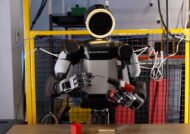
Space-time simulation handles both space and time from video. Footage from three to five ordinary smartphones fixed on tripods can be reworked into "bullet time" style shots that freeze time and orbit the viewpoint. For robotics, the intended "Real-to-Sim" workflow reconstructs a real space in 3D and then generates the RGB images and depth data a virtual robot's cameras would see as it moves through it.
Image generation is positioned as a secondary capability, but it follows complex prompts, renders text, supports a wide range of visual styles, and can produce 360-degree panoramas from text or images.
Output as Point Clouds and 3D Gaussian Splats
In games, VFX and robotics development, explicit 3D data is needed alongside images and video. Because Atlas estimates depth at the same time as it generates new views, it can output an entire 3D world from a single photo. From a video of a real space, it predicts the depth of every frame and stitches them together into a 3D reconstruction.
Two output formats are supported: point clouds and 3D Gaussian splats. A point cloud is only an estimate of geometry, but converting it into Gaussian splats yields a finished scene that renders on-device at high resolution and frame rates. This is the same representation used by the company's existing product "Marble," and Atlas is slated to become the foundation for future versions of Marble and other World Labs products.
A Design That Borrows the Best of LLMs and Video Models
Technically, Atlas is described as a "multimodal autoregressive diffusion transformer." It is a long name, but breaking it down reveals the design philosophy.
"Multimodal" refers to directly processing text, images, camera poses and 3D depth maps. Video is treated as a sequence of images, and every image and depth map is tied to an explicit camera pose. Just as an LLM holds a sequence of tokens as its context, Atlas holds a "spatial context" in which each image is anchored at a position in 3D space, and it generates the next element from that context. Placing two unrelated images in 3D space and having the model imagine the corridors and rooms that connect them is a use case unique to this mechanism.
"Autoregressive" means outputs are generated one element at a time following the inputs, so different tasks can all be treated uniformly as "a sequence where outputs follow inputs." "Diffusion" refers to producing outputs by progressively removing noise (Atlas is a rectified flow model), which suits high-dimensional continuous data such as images and video and lets speed and quality be traded off through the number of inference steps. "Transformer" is the matrix-multiplication-centric backbone that maps well onto modern hardware.
The advantage of this combination is that Atlas can adopt acceleration techniques from the LLM side (KV caching, cache-aware routing, disaggregated serving and so on) as well as techniques from the image and video model side (diffusion distillation, classifier-free guidance, shifted noise schedules, improved VAE designs and more).
Evaluation and the Outlook for Scaling
The company presents comparison results for two tasks: camera-controlled generation and 3D reconstruction. For camera control, each model was given a single image plus a combination of camera moves such as pans, trucks and cranes, and third-party raters judged which model followed the instructions more closely. The conditions are not identical, since Atlas accepts camera information directly while the competing video models received the motion as text, but the company says Atlas's advantage widened as camera paths grew more complex. In 3D reconstruction, it reportedly outperformed specialized open-source models as well.
Note that all of these figures are World Labs' own measurements, and no paper, model card or code has been released this time. The company says new capabilities emerged each time it increased training compute, and it expects performance to keep improving with scale.
Summary
Atlas, announced by World Labs, is a world model that handles text, images, video and 3D in a single model, covering camera-controlled video generation up to one minute at 1440p, 3D reconstruction from a few photos, reframing of video, and simulation for robotics. Because it can output 3D Gaussian splats, it connects directly to the existing product Marble. At present it is available only through early access for selected partners, and the timing of general availability, pricing and model size have not been disclosed. How close AI that "understands and generates" space is to practical use will be worth watching.