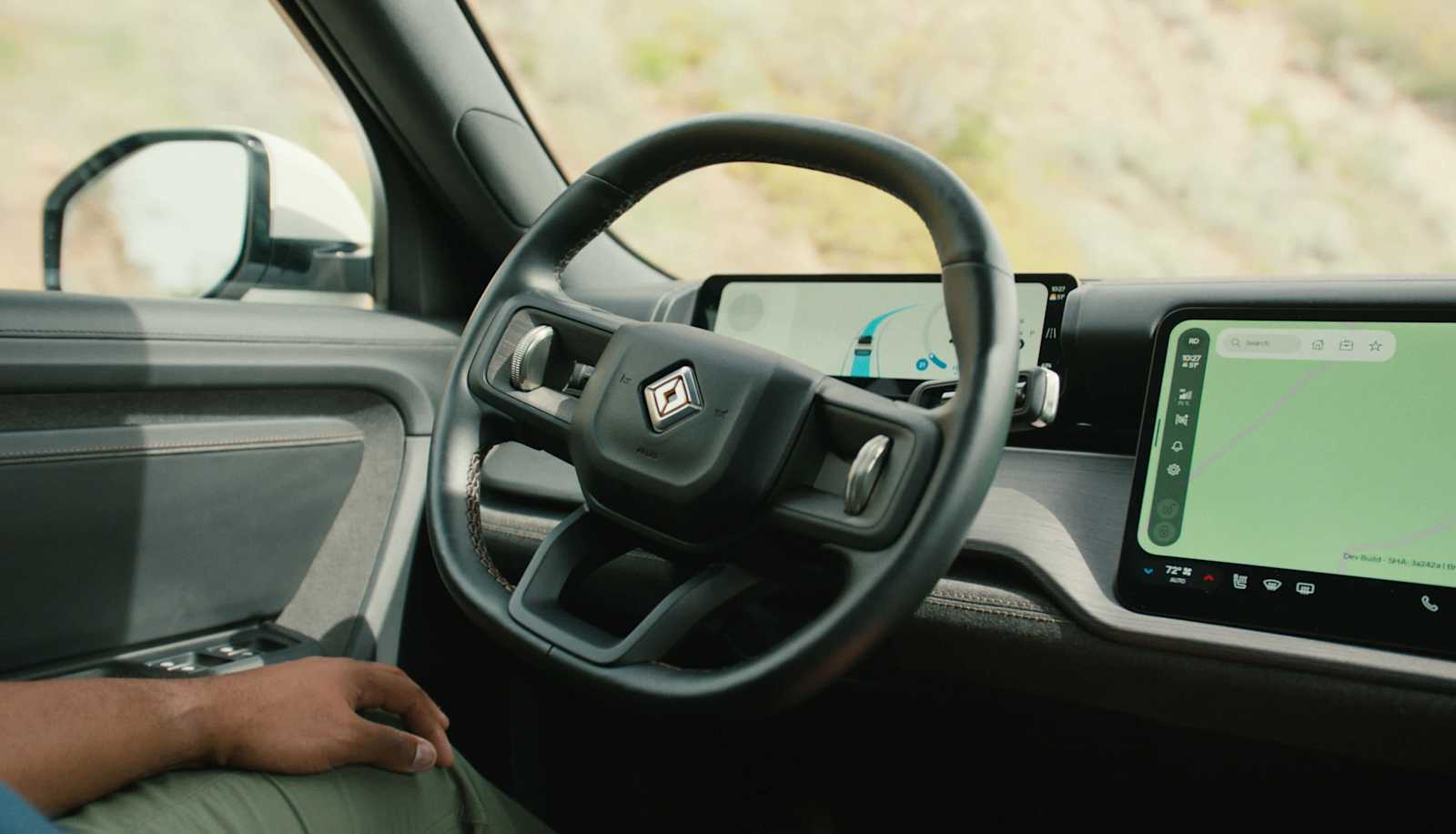
Rivian is climbing the autonomy ladder one rung at a time, and the climbing gear is silicon it designed itself. The R2, the SUV that started reaching driveways in August, already drives hands-free. The third-generation autonomy platform — two of Rivian's own RAP1 chips for a combined 1,600 TOPS of inference performance — is expected to ship on R2 models from late 2026. In 2028, the same vehicle is scheduled to start carrying passengers as an Uber robotaxi.
Hands-Free Driving Already Covers 3.5 Million Miles of Road
Rivian bundles its driver assistance features under the name Autonomy+. The centerpiece, Universal Hands-Free, works on roughly 3.5 million miles of roads in the US and Canada. On any road with clearly painted lane markings, an indicator appears on the driver display and a double-pull of the right stalk lets the driver take both hands off the wheel.
A recent software update extended Lane Change on Command beyond highways, so a flick of the turn signal is enough for the vehicle to find a gap and move over. The driver display now also renders traffic lights, stop signs, and traffic cones.
Pricing is 49.99 USD per month or a one-time 2,500 USD. The one-time purchase stays attached to the vehicle, so it transfers to the next owner on resale. Every new Rivian includes a 60-day free trial, and buyers who choose the R2 Performance with Launch Package get Autonomy+ for the life of the vehicle at no extra cost. Set against the 99 USD per month Tesla charges for Full Self-Driving (Supervised), the subscription lands at roughly half the price.
The Next Milestone Is Typing In an Address
Point-to-Point is the next target. Enter a destination and the vehicle handles the whole route, from city streets through highway interchanges, under the driver's continuous supervision. A limited rollout is planned before the end of this year, with a wider customer rollout targeted for 2027.
Rivian argues the gap between hands-free and point-to-point is smaller than it looks from outside. Lane keeping and lane changes are already running in customer cars, which leaves intersections and traffic signals as the remaining work.
A 5 nm Chip Built for Autonomy and Nothing Else
RAP1 is what makes that plan possible. Fabricated on TSMC's 5-nanometer process, it packs compute and memory onto a single multi-chip module and adds RivLink, a low-latency interconnect that lets chips be ganged together to multiply performance. Two of them make up ACM3, the third-generation autonomy compute module, rated at 1,600 sparse INT8 TOPS and 5 billion pixels per second.
NVIDIA's automotive SoC, Drive AGX Thor, is quoted at 1,000 TOPS for a single chip, so in raw numbers the two sit on similar ground. The difference is in the design premise. A general-purpose part has to spend silicon on infotainment and display duties, while RAP1 exists to run autonomy inference and nothing else. Developing the chip and the AI model on the same schedule also changes the terms compared with buying a part off the shelf.
Founder and CEO RJ Scaringe said when the Uber partnership was announced that the combination of Rivian's growing data flywheel, RAP1 as an in-house inference platform, and a multi-modal perception platform is what makes rapid progress toward Level 4 realistic.
Eleven Cameras, Five Radars, and One Lidar
The third-generation platform pairs 11 cameras totaling 65 megapixels with 5 radars and 1 lidar unit. Rivian describes it as one of the most powerful combinations of sensors and inference compute in a consumer vehicle in North America.
Keeping lidar in the stack is what defines this approach, in contrast to Tesla's camera-only route. Cameras capture color and texture but struggle in darkness and low contrast, lidar measures three-dimensional shape regardless of lighting, and radar sees through rain and snow. Layering sensors whose weaknesses do not overlap keeps the system from collapsing when one of them has a bad moment.
The resulting data flows back from customer vehicles as real-world driving records. Three-dimensional point clouds included, it trains what Rivian calls its Large Driving Model, and updated models are pushed back to vehicles over the air. The loop that makes the car better the more it drives runs on Rivian's own vehicles and Rivian's own chips.
Uber Is Backing It With Up To 1.25 Billion USD
Uber is the commercial partner. Under the agreement announced on March 19, 2026, Uber will invest up to 1.25 billion USD in Rivian through 2031, contingent on hitting specific autonomy milestones by specific dates. An initial 300 million USD was committed after signing, subject to regulatory approval.
Uber or its fleet partners are expected to purchase 10,000 fully autonomous R2 robotaxis in the first phase, with an option to negotiate up to 40,000 more starting in 2030. Service begins in San Francisco and Miami in 2028 and is planned to expand to 25 cities across the US, Canada, and Europe by the end of 2031. The vehicles will be available exclusively through the Uber platform.
Uber CEO Dara Khosrowshahi pointed to Rivian designing the vehicle, the compute platform, and the software stack together while keeping manufacturing and supply in the US as the reason for the commitment. In robotaxi programs, the company building the car and the company building the driver are usually two different firms. Consolidating both under one roof is what Uber cited as the basis for its targets.
Summary
Rivian has chosen to own the whole vertical stack: the chip, the driving model, the vehicle, and the commercial fleet. Hands-free driving is already live in delivered cars, Point-to-Point arrives in limited form this year, and robotaxis follow in 2028. The sequencing is worth noting. Level 4 gets proven in a managed commercial fleet first, and the capability is handed down to retail vehicles afterward. For a company that is badly outnumbered on volume, building it up in that order may be the only route available.