South Korean security company AhnLab announced on November 26, 2026, through its research center ASEC (AhnLab SEcurity intelligence Center), that some installers for "Q-Dir" and "DesktopOK," free Windows utilities published by SoftwareOK, had been tampered with. The modified files were distributed through the software's official website and were built to install a remote access trojan (RAT) written in Python.
Tampering was confirmed in five versions
Q-Dir is a file manager that can show four folders at once, while DesktopOK saves and restores the layout of desktop icons. As of this writing, AhnLab has confirmed tampering in the following versions.
| Software | Versions confirmed as tampered |
|---|---|
| Q-Dir | 12.85.0.0 / 12.84.0.0 / 12.83.0.0 |
| DesktopOK | 12.85.0.0 / 12.82.0.0 |
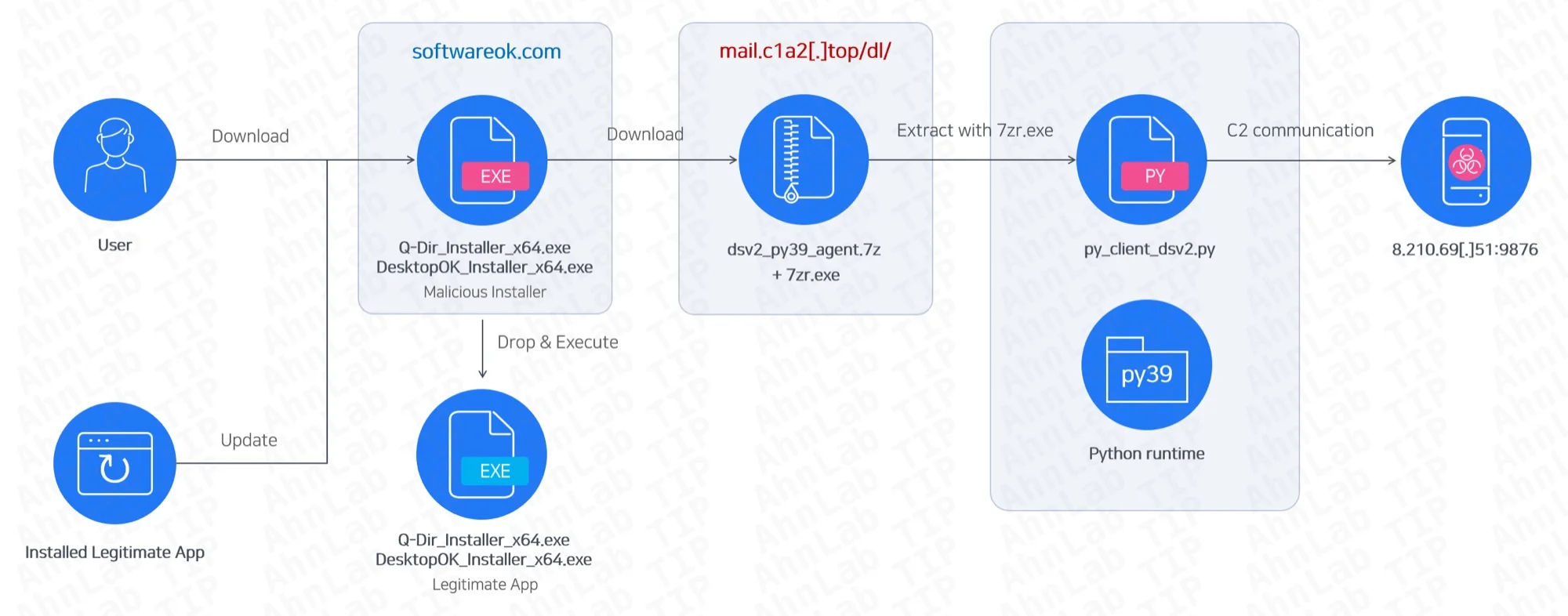
The malicious files reached users through SoftwareOK's official distribution path, not through unofficial download sites or advertising pages. They were produced both when users downloaded directly from the official download page and when previously installed copies went through the update process. The SHA-256 hashes of the downloaded files did not match the values posted on the official page. AhnLab also warns that users of other versions may be at risk if they installed or updated during the distribution period.
The legitimate app runs while malware is installed in the background
The tampered installers carry a legitimate Q-Dir or DesktopOK executable inside them. When run, they write that legitimate executable to "C:\Users\Public" and launch it, so the software appears to work normally. That legitimate executable also carried the developer's valid digital signature.
In the background, meanwhile, the installer downloads "7zr.exe," a legitimate tool for extracting archives, along with a package bundling a Python runtime and the RAT from an external server. The package is extracted to folders such as "C:\ProgramData\Microsoft\DeviceSync\b2" and kept running through a Task Scheduler task named "MicrosoftEdge_dcntel," disguised to look like Microsoft Edge. Because Python is bundled, the malware works even on PCs without Python installed.
The RAT can run shell commands and take screenshots
The main RAT capabilities AhnLab confirmed are running shell commands and Python code, uploading and downloading files, capturing screenshots, and collecting OS and system information. It can also run additional malware on the attacker's instructions.
The RAT also compares the names of processes running on the PC against an internal list of 1,206 process names and sends any matches to the attacker's server. The list includes Korean and international security products such as AhnLab V3, CrowdStrike Falcon, Trend Micro, ESET, Kaspersky and Sophos. Although Chinese was used in places such as comments in the Python code, AhnLab has not identified the attacker.
AhnLab says the cause and the path by which the files on the official site were replaced have not been identified. As of this writing, no notice about the tampering can be found on SoftwareOK's official website.
Users should reinstall and check for traces
AhnLab advises users of Q-Dir or DesktopOK to uninstall the software and then reinstall the latest version that has been verified as safe. Before reinstalling, users should check that the SHA-256 value posted on the official download page matches that of the downloaded file.
One point to watch is that uninstalling alone may leave the RAT in place. AhnLab urges users to check for suspicious Python environments, Task Scheduler tasks, related files and traces of external communication. It also recommends updating antivirus software and running a full scan, and, if an infection is found, disconnecting the PC from the network and assessing the extent of the damage.
Details are available in AhnLab's announcement. The download pages for the software are Q-Dir and DesktopOK.
Our Take
Because the files came from the official site and the legitimate software runs properly, it would be nearly impossible for users to notice anything wrong on their own. AhnLab's disclosure is practical for users, pointing to the hash mismatch as a clue and publishing the task names and folders to check. That said, since the cause of the replacement is unknown, users can only confirm whether files currently being distributed are safe by checking their hashes. Even so, people who don't use these programs have no reason to panic, and for those who do, starting by checking for the task and folders seems the realistic first step.
Summary
AhnLab revealed that official distributions of the free utilities Q-Dir and DesktopOK were tampered with to carry a remote access trojan. Windows users who installed or updated either program during the distribution period are affected. The cause of the replacement is still unknown, and an explanation from SoftwareOK is awaited.