On September 1, 2026, Perplexity announced Hybrid Compute, a new capability for its Perplexity Computer agent platform that splits a single task between frontier models in the cloud and a local model running on a Mac. Data you never want to leave your machine, such as client records or contracts, is handled by the on-device model, while research and heavy reasoning go to the cloud. Any Apple silicon Mac can use it without extra hardware.
One task, divided between the cloud and the device
Perplexity Computer, introduced in February 2026, is an agent platform that combines models, files, tools, and web access to complete multi-step work. In April, Perplexity added Personal Computer, which lets the agent work directly with the files and apps on a Mac. Hybrid Compute builds on that foundation.
The idea is simple. Computer takes one task from the user and carves it into cloud-bound and device-bound parts. The frontier model in the cloud takes on advanced reasoning, web search, and planning. The local model on the Mac reads private files, handles sensitive information, and performs any on-device actions the task requires. Users do not have to split the job into separate prompts or move results between tools by hand; Computer coordinates the whole workflow.
Before work begins, the app shows which files it proposes to keep on the device, so you can check nothing was missed. At the same step you choose which model runs locally and which runs in the cloud.
A privacy gate watches what leaves the Mac
At the heart of the feature is a privacy gate that runs on the Mac. A newly trained Perplexity classifier operates on the device and identifies sensitive elements such as names, addresses, account numbers, and credentials before anything is sent to the cloud. Depending on what it finds, the gate can mask the details, keep the content local, refuse the action, or ask the user for consent.
Login credentials, payment card numbers, and government-issued ID numbers receive the strictest treatment: they are either kept on the device or stripped out so the cloud model can continue without them.
On the same day, Perplexity published the research behind the classifier. PII-TRACE is a benchmark that tests whether a detector can catch every repeated mention of the same personal identifier across a long, multi-turn conversation, and PII-Tracer is a 0.6-billion-parameter detection model. The benchmark spans 13 languages and 13,148 conversations. In Perplexity's evaluation, PII-Tracer found every mention of 79.4 percent of recurring identifiers, compared with 57.0 percent for a leading cloud model used as a comparison. Both are slated for release soon.
Admin rules and audits for organizations
The design clearly targets legal, healthcare, financial, and other teams that handle confidential data every day. In Perplexity's examples, an investment team gathers public filings and market data in the cloud while a local model cross-references confidential deal documents and extracts key terms. An ad agency researches trends in the cloud but reviews unreleased creative on the device. A lawyer researches case law on the web while summaries of privileged documents are produced on the Mac.
For Enterprise subscribers, administrators can set organization-wide rules that define what must stay on the device, what may be masked before cloud use, and what requires user approval before going to the cloud. There is also an audit trail showing when information left a device, giving teams a consistent policy to operate under.
Requirements and available models
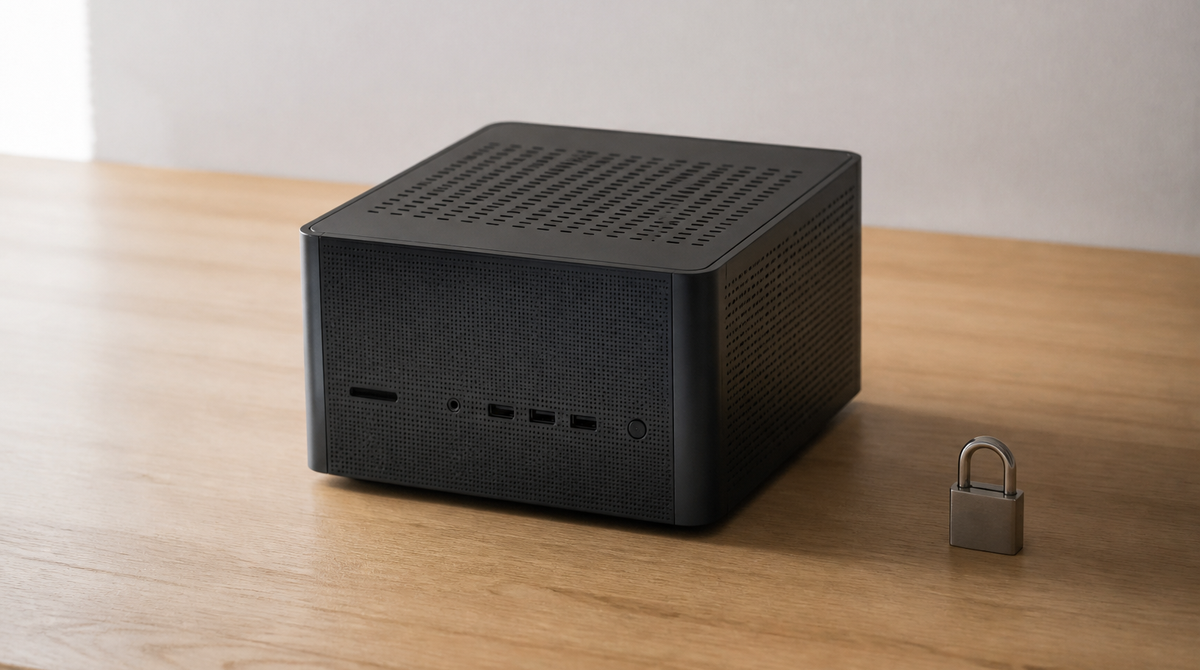
Hybrid Compute is available now to Pro, Max, and Enterprise subscribers. It runs on Apple silicon Macs with macOS 15 or later and at least 24 GB of unified memory. Some guidance suggests 32 GB or more for comfortable use, and the new Mac mini and Mac Studio announced in August are named as ideal platforms.
Three local models are offered at launch: Google's Gemma 4 E4B, Alibaba's Qwen3.6 35B-A3B, and a Qwen-based model that Perplexity post-trained specifically for Perplexity Computer. Installation does not require the terminal; models download with one click from the Mac app, and Perplexity says more options will follow.
While a task runs, the app visualizes CPU, GPU, and memory usage on the Mac and displays how many tokens the task has consumed. Tokens generated by the local model are free; charges apply only to cloud model usage. Tasks can also be queued from an iPhone, so an always-on Mac mini can serve as a private local engine you reach from anywhere.
The user decides the trade-off with cloud-only quality
The obvious question is how output quality compares with a fully cloud-based run. Jon Staff, who oversees Perplexity's Mac products, acknowledges that a fully frontier pipeline will almost always produce better raw output. But not everyone needs the most capable model for their work, he argues, and in many cases privacy and cost matter more. The balance should be a sliding scale the user controls.
That candor is welcome. Rather than overselling local models, Perplexity is explicit about the division of labor: what must be protected stays on the device, and what needs raw capability goes to the cloud. Combined with August's Portable Computer for NVIDIA DGX Spark, which keeps everything on the machine, the company is filling in the spectrum between fully cloud and fully local in fine increments.
Summary
Perplexity's Hybrid Compute splits one task between frontier cloud models and a local model on the Mac, with an on-device privacy gate protecting sensitive information along the way. It is available to Pro, Max, and Enterprise subscribers on Apple silicon Macs running macOS 15 or later with at least 24 GB of unified memory. With no charge for locally processed work, it offers a practical middle ground for bringing AI agents into sensitive business workflows.