On September 8, OpenAI published a proof resolving the Navier–Stokes existence and smoothness problem, one of the seven Millennium Prize Problems[1]. The proof came from an unreleased internal model that the company describes as significantly more capable than GPT-6 Astra. A question that had stood open for roughly 90 years was reached by AI first.
An internal model reaches a 90-year-old problem
The Navier–Stokes equations apply Newton's second law of motion to fluids, describing how liquids and gases move[1]. They treat a fluid as a continuous medium rather than tracking individual molecules, and they underpin aircraft design, weather forecasting, and the study of blood flow.
The open question was whether that continuum approximation can break down. Can a three-dimensional incompressible fluid of constant density, starting from smooth motion, develop a singularity in finite time? A singularity here means fluid speeds growing without bound within a finite window. Viscosity tends to smooth motion out, so the question was whether a blowup could occur in spite of it.
The equations trace back to the nineteenth-century work of Claude-Louis Navier and George Gabriel Stokes. In 1934, Jean Leray proved that solutions exist in a generalized sense, but whether they always stay smooth remained unanswered. In 2000, the Clay Mathematics Institute named the problem one of the seven Millennium Prize Problems[1].
What OpenAI's internal system produced is an analytical proof that an initially smooth fluid at rest can develop a singularity in finite time, together with a formalization in the Lean proof assistant. By establishing statements C and D in the official Millennium Prize formulation, the company says the problem is resolved[1].
The solution is a vortex stretched like spaghetti
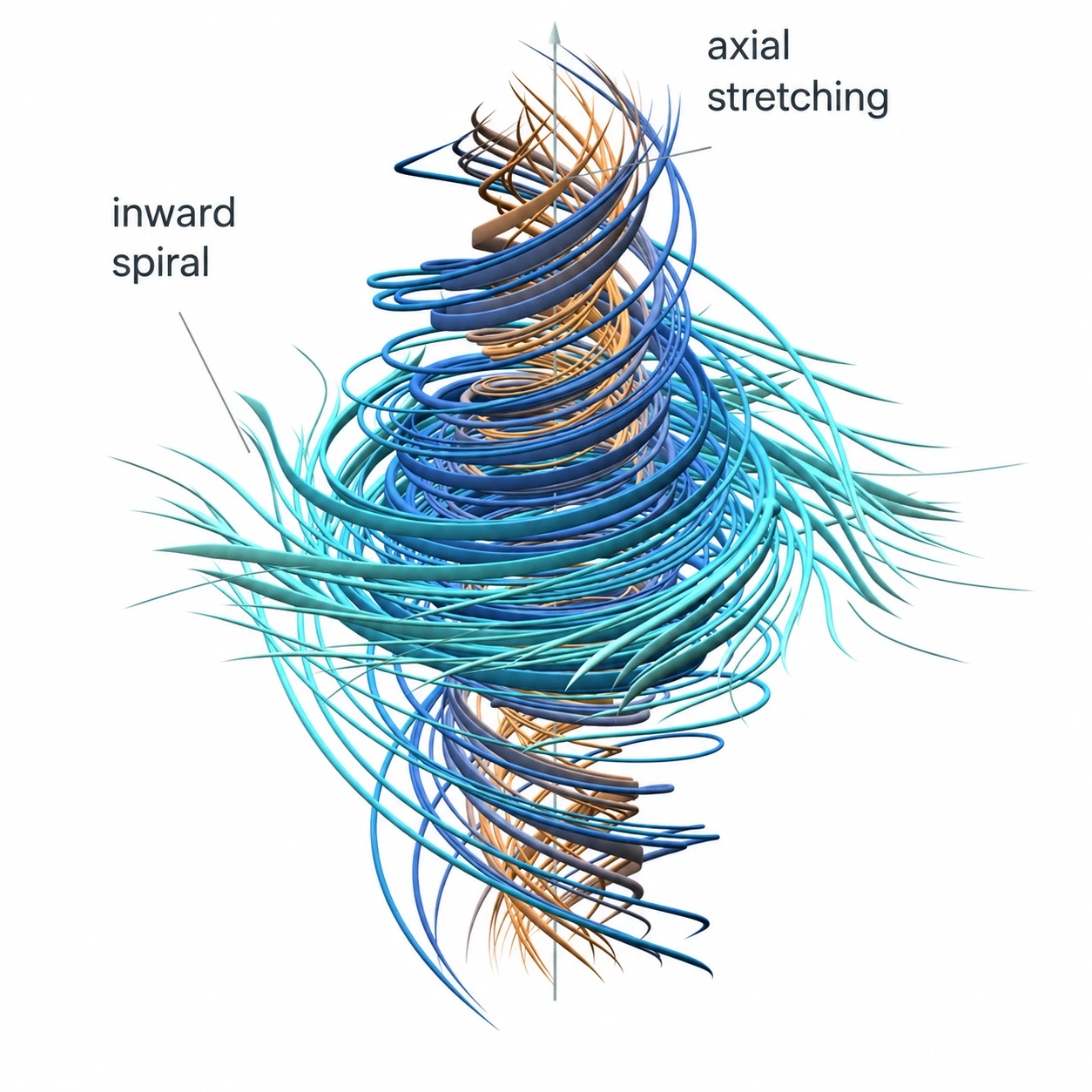
The solution the proof describes is a vortex[1]. It spirals inward while being drawn out into an increasingly elongated shape, like spaghetti. The central region shrinks as it speeds up, and the total energy stays finite throughout, as the laws of physics require. Only the velocity diverges.
The technical difficulty is that the breakdown has to arise from the fluid's own motion rather than from an infinite force applied by hand. Acceleration, pressure gradients, momentum transfer, and viscosity all have to grow large while cancelling in a precise way. That balance is what leaves the external force smooth even as the velocity grows without bound.
10,000 agents, 88 hours: the effort by the numbers
The work ran on a system of coordinating agents[1]. The agents could read from a cached version of the internet and run code, and they communicated within assigned groups. The group that produced the Navier–Stokes result involved on the order of 10,000 concurrent agents.
The timeline is short. Training of the new internal model began on August 28. On September 1, OpenAI heard rumors that two Millennium Prize problems had been resolved and launched an evaluation across the remaining ones. The agents reached their resolution on September 5, about 88 hours after the first agents were launched. Lean formalization and verification took another 17 hours via GPT-6 Astra[1].
The compute figures were disclosed as well. Across all attempted problems, the agents sent 4.9 million messages and used about 300 billion output tokens. The Navier–Stokes effort alone accounted for 2.7 million messages and roughly 130 billion output tokens[1]. On a call with reporters, company executives put the cost of solving the problem in the millions of USD (hundreds of millions of yen)[2].
The way the agents were run mattered too. Different groups received different variants of the problem statement, with versions A and B pointing toward a proof and versions C and D toward a disproof. Partway through, Codex was used to consolidate the most useful insights from each group and feed them back as follow-up prompts, a kind of cross-pollination[1].
Before the main target, the agents were also given a supposedly easier task: the regularity problem for the Euler equations, which is Navier–Stokes with the viscosity term removed. Working on the unforced version, nearly 100 agents collaborated for about 50 hours and produced a disproof. Seeing that result is what prompted OpenAI to concentrate its resources on Navier–Stokes[1].
A dispute over credit surfaces alongside the result
The announcement arrived with friction over how it came about. OpenAI says the rumor it heard on September 1 concerned work by Levent Alpöge, an Anthropic employee, and Tristan Buckmaster, a mathematics professor at NYU[1]. After completing Lean verification on September 6, OpenAI says it contacted the pair to offer a concurrent release and recognize their priority, and only then learned that their result concerned the forced Euler problem.
Buckmaster has publicly questioned whether OpenAI pursued a research direction it learned about from their work, and raised concerns about whether private Codex material could have played a role[2]. OpenAI denies it, saying neither its researchers nor its agents saw the pair's work before it was released publicly. On a call with reporters, chief research officer Mark Chen said no people or AI systems searched through user data to solve the problem, adding that he was disappointed by the allegations[2].
OpenAI says it does not intend to claim the 1 million USD (about 150 million yen) Millennium Prize for this result[1][2]. The company frames the release as a report on how fast its models are advancing, calling it a snapshot of AI progress rather than a culmination.
※1 USD = 154 JPY (as of September 8, 2026)
It is worth noting that the proof itself has not yet been vetted and accepted by the wider mathematical community. OpenAI has released both the written proof and the Lean formalization, but independent verification by outside mathematicians is still ahead.
Summary
OpenAI says an unreleased internal model and roughly 10,000 concurrent agents reached a proof of finite-time singularity for the Navier–Stokes equations in about 88 hours. The result is published together with a Lean formalization, and the effort consumed around 130 billion output tokens. At the same time, a disagreement over credit emerged with mathematicians working on closely related problems. AI reaching the frontier of mathematics, and questions about how it got there, arrived on the same day.
Source: https://openai.com/index/navier-stokes-solution
Source: https://www.axios.com/2026/09/08/openai-math-solution-navier-stokes-credit