ChatGPT maker OpenAI is reportedly preparing its first in-house hardware: a voice-first wearable earpiece. Inside the company it is said to carry the development codename "Sweetpea," while a consumer release may use the name "Dime." The latest supply-chain reports suggest manufacturing plans are firming up, with some observers expecting a launch before the end of 2026. Nothing has been officially confirmed, but here is a look at where the rumors stand.
The Core of the Rumor: Worn Behind the Ear
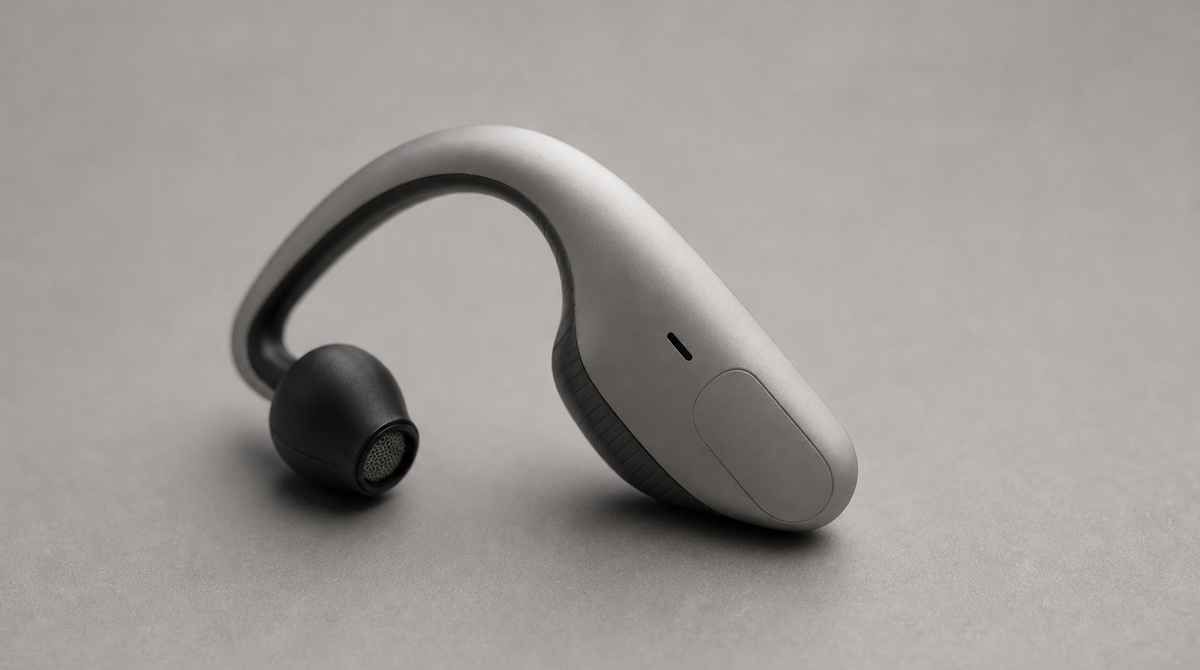
The most striking detail this time is the shape. According to the leaks, Sweetpea would not push into the ear canal like a typical wireless earbud. Instead, most of the hardware would sit behind the outer ear in a "behind-the-ear" design, with only smaller parts—likely a speaker driver or sensor array—detaching to reach the ear. The result is said to resemble a modern hearing aid more than a pair of Apple AirPods.
There are practical reasons for this layout. Placing the battery and processor behind the ear makes room for a larger-capacity cell and helps dissipate heat. Both matter for a device meant to run AI models while listening for voice commands all day. Leaving the ear canal open also makes the device more comfortable for continuous wear, which suits an assistant intended to stay on.
Possibly More Than a Bluetooth Earbud
The leaked internal layout reportedly references an "ultrasonic transmitter" and signal pickup sensors. If accurate, that suggests Sweetpea would do more than passively relay ChatGPT's voice over Bluetooth—it could read the surrounding environment and respond with awareness of context, understanding the situation the wearer is in.
OpenAI's device was originally conceived as an ambitious "smartphone-class" product that handled AI processing on the device itself. High component costs, especially for memory, are said to have pushed the company to scale the plan back to a simpler, audio-focused wearable that leans on cloud services such as ChatGPT. Some reports mention a custom 2-nanometer processor, though that detail is far from confirmed.
Manufacturing Moves Point Beyond Prototyping
The most concrete element of the rumor is the manufacturing shift. OpenAI is said to have moved its production partner from the smaller Luxshare to manufacturing giant Foxconn (Hon Hai), with production planned in Vietnam.
In hardware, moving from a nimble design house to a mass-production specialist like Foxconn is usually read as a sign that a project has graduated from prototyping into a product meant to ship. On timing, observers point to the second half of 2026, with September seen as a likely window. An OpenAI executive has publicly said the company is preparing to announce its first hardware device in the second half of 2026, broadly matching the leaked timeline.
Designed by Former Apple Lead Jony Ive
The effort is said to be led by Jony Ive, the former Apple designer known for the iPhone. In 2025, OpenAI acquired io, the AI device startup he founded, for about 6.5 billion USD (roughly 1 trillion yen), placing it at the center of its hardware push. A design philosophy that favors a calm presence and intuitive, voice-driven control is described as a deliberate rethink of how we constantly stare at our smartphones today.
※1 USD = 160 JPY (as of June 16, 2026)
Can It Survive the AI Gadget Graveyard?
For all the anticipation, dedicated AI devices have a rough track record. The much-hyped Rabbit R1 handheld and the chest-worn Humane AI Pin both failed to win a lasting place in the market. AI-forward hardware was everywhere at CES 2026 in early 2026, yet few such products have settled into everyday life.
Even so, OpenAI holds a widely used entry point in ChatGPT, and delivering AI through the familiar form of an earbud could spread differently than past AI gadgets. That said, OpenAI itself has not officially acknowledged the device. For now this remains a supply-chain rumor, and the final specs and launch timing could still change.
Summary
The idea that OpenAI's first in-house hardware will be a behind-the-ear AI earpiece is gaining specificity as the manufacturing picture takes shape. The development codename is said to be "Sweetpea," the consumer name "Dime," with production reportedly moving from Luxshare to Foxconn and the build site shifting to Vietnam. A launch within 2026, around September, is seen as likely—though none of this is confirmed. Whether former Apple designer Jony Ive's vision of "AI you use by voice" can clear the wall that tripped up the Rabbit R1 and Humane AI Pin is the question worth watching.