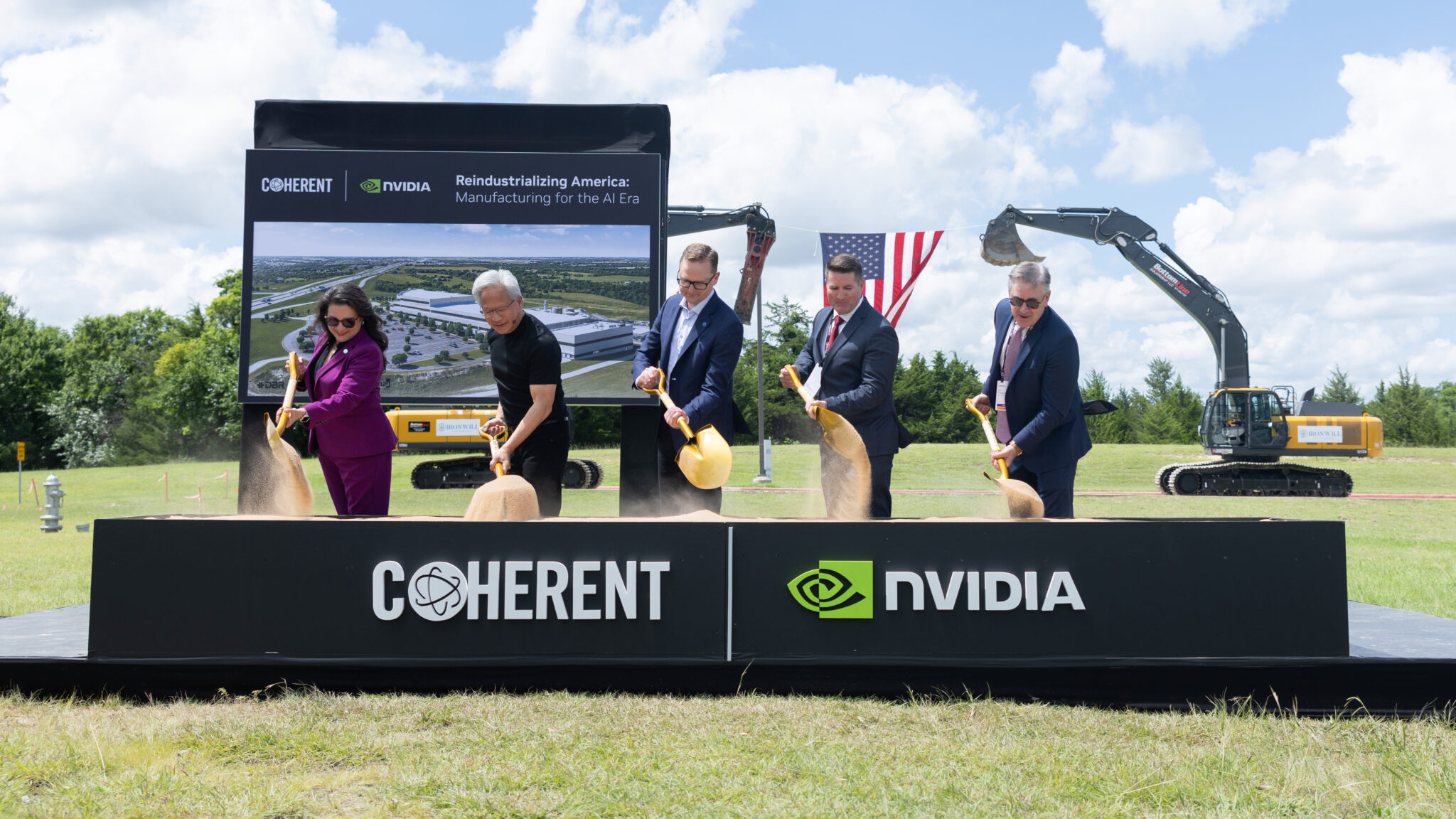
AI now moves at the speed of light. NVIDIA has invested 2 billion USD (about 320 billion yen) in Coherent, the optical-semiconductor maker behind that "wiring of light," and the two companies are partnered on optics technology for next-generation AI infrastructure[1][2]. Coherent has now broken ground on an expanded manufacturing building in Sherman, Texas. Here is a look at why light, rather than copper wiring, is becoming the backbone of AI infrastructure.
Why AI Needs "Wiring Made of Light"
NVIDIA's next-generation systems connect hardware at a vastly larger scale. The Vera Rubin Ultra NVL576, for example, bundles eight NVLink racks—each holding 72 Rubin Ultra GPUs—into a single system of 576 GPUs[1]. Across distances that large, conventional copper wiring can no longer carry signals fast enough.
As signaling rates rise, the distance copper can hold a signal shrinks[1]. Trying to span eight racks with copper would burn power on the circuits that condition the signal—power a data center would rather spend on compute. The answer is silicon photonics, the technology that converts data into light to move it. Switching from electrical to light carries a one-time penalty, but once the data is in light form, loss over distance is almost nil[1]. At the scale of NVL576, NVIDIA says light becomes the most power-efficient option.
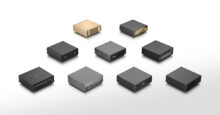
What Coherent builds is the parts that make this possible. Its pluggable optical modules are transceivers roughly the size of a USB stick that plug into the front of NVIDIA networking switches and carry data between racks where copper cannot reach[1]. Each module contains a single laser made from indium phosphide (InP), a compound semiconductor.
What the Texas Expansion Will Scale
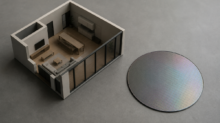
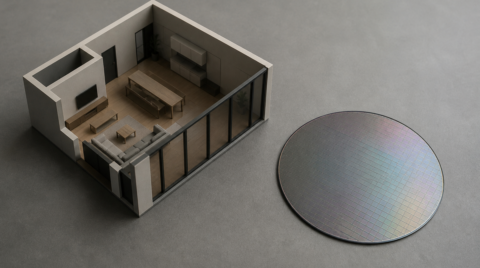
The work that just broke ground is an expansion of the manufacturing building at the existing Sherman site[1]. It will scale production of the InP wafers that form the foundation for data moving at the speed of light between chips, servers and data centers. Coherent runs what it calls the world's first 6-inch indium phosphide line.
The key is wafer size[1]. While silicon fabs run on 12-inch wafers, much of the world's InP production is still stuck on 3- and 4-inch wafers. Because wafer area scales with the square of the diameter, moving from 3-inch to 6-inch roughly quadruples the usable area, yielding more components per run and lowering cost. It took 50 years to build the first line, yet the capacity was reportedly quadrupled in a single year—a measure of the momentum behind AI demand.
At full capacity, this site alone is expected to support more than 550 direct jobs[1]. The semiconductor laser was originally born in U.S. labs, where Bell Labs demonstrated a room-temperature version in 1970. Much of the technology and its manufacturing later moved overseas, but Coherent has been a U.S. manufacturer since its founding in 1971.
The 320-Billion-Yen NVIDIA–Coherent Partnership
This expansion builds on a deepening relationship between the two companies[1]. NVIDIA and Coherent have worked together for roughly two decades, and in March 2026 they moved into a multiyear strategic partnership[1][2]. NVIDIA is investing 2 billion USD (about 320 billion yen) in Coherent to support research and development, future capacity and U.S.-based manufacturing, alongside a multibillion-dollar commitment to purchase advanced laser and optical networking products[2].
NVIDIA itself has committed to producing up to 500 billion USD (about 80 trillion yen) of AI infrastructure in the U.S. through industry partnerships, with new sites in Arizona and Texas[1]. The Texas expansion is also backed by a 50-million-USD (about 8-billion-yen) grant from the U.S. CHIPS Act, which aims to bring chip manufacturing back home.
*1 USD = 160 JPY (as of June 16, 2026)
Optical parts rarely grab the headlines that logic chips do[1]. But as GPUs scale up, the ability to connect them matters as much as the ability to compute. Coherent CEO Jim Anderson put it this way: AI runs on compute, but it scales on connectivity—and the organization that supports that connectivity is taking root in Sherman.
Summary
Coherent, in which NVIDIA has invested 2 billion USD, has broken ground on an expanded optics fab in Sherman, Texas[1]. What it will scale up is the indium phosphide wafers that serve as the "wiring of light" for AI infrastructure. In an era when hundreds of GPUs operate as a single system, light is replacing copper as the main carrier of data. It is not a flashy product, but as the groundwork that lets AI grow in scale, these easily overlooked components are set to take on a steadily larger presence.
[1] https://blogs.nvidia.com/blog/coherent-texas-ai-optical/