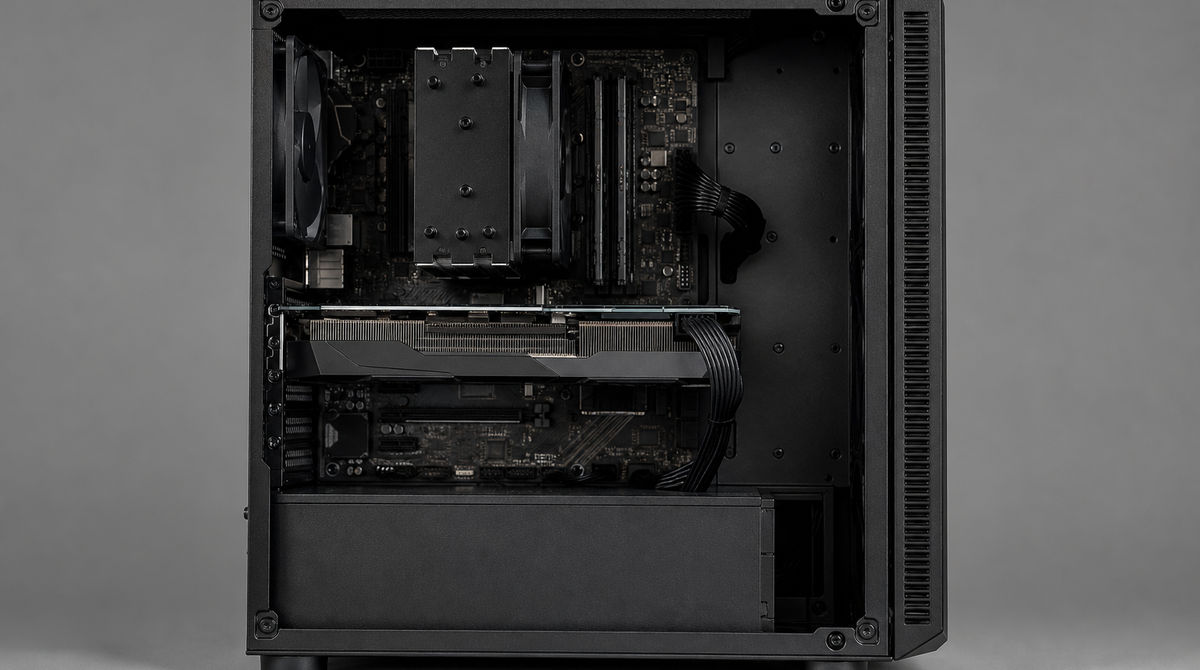
Microsoft has begun extending Windows 11's local AI capabilities past the boundaries of Copilot+ PCs. According to updated developer documentation, PCs equipped with an NVIDIA GeForce RTX 30-series GPU or newer and at least 6GB of video memory (VRAM) can now run the language model APIs built into Windows locally. For now it is an experimental, developer-only change, but it hints that Microsoft is starting to rethink how tightly it has tied on-device AI to the Copilot+ brand.
The Copilot+ PC rules built around the NPU
Copilot+ PCs arrived in June 2024 with a clear message: running AI locally requires dedicated AI hardware. These machines were defined around the NPU (Neural Processing Unit) that handles AI workloads, alongside baseline requirements such as 16GB of memory and an SSD. The NPU in particular was positioned as the key that unlocked local AI features in Windows.
Yet NPUs are not the only chips that can handle AI work. GPUs were designed from the outset for massive parallel computation and have long been used to run machine learning models. In terms of raw throughput, there are plenty of AI workloads where a modern GPU outpaces today's NPUs. Power draw tends to be higher, but for sheer horsepower the GPU has the advantage.
Even so, Microsoft kept most of its built-in AI features confined to NPU-equipped machines. As a result, even PCs with powerful GPUs were left unable to reach local text and image generation, or features such as Windows Recall.
How local language models run on the GPU
Now that gap is narrowing. In updated documentation and a post on GitHub, Microsoft confirmed that supported GPUs can run the language model APIs even on non-Copilot+ PCs. The newly added capability is framed as "Language Model APIs on GPU (Experimental)," with supported hardware listed as NVIDIA GeForce RTX 30-series or newer with 6GB or more of VRAM.
At the center of this is a compact on-device model called Phi Silica. Rather than shipping pre-installed on every PC, it is downloaded through Windows Update when an app calls for it. Once installed, it runs on the device without relying on the cloud, using the GPU when one is available.
Keeping everything local brings concrete benefits. Reducing dependence on cloud processing makes responses feel snappier, and data stays on the machine rather than being sent to external servers. For developers and enterprise users, that can be a real factor in how AI features get adopted.
Developer-only for now, with text tasks at the core
That said, the feature is not yet exposed directly to everyday users; it sits within the developer layer. Using it means building or relying on an app that taps into the Windows AI framework. Still, the groundwork is in place for local AI to reach a far wider range of Windows machines.
For the moment, the capabilities center on handling text. Through the Windows.AI.Text APIs, apps can summarize text, rewrite it, convert it into structured formats, and generate prompts. It delivers functionality close to what people expect from cloud AI tools, but runs entirely on the device.
At the same time, the rollout remains partial. Prominent Copilot+ features such as Windows Recall and Click to Do are still tied to NPU-equipped machines. GPU support, at this stage, is limited to the language model API layer rather than the full suite of AI integrations.
Summary
With this change, Microsoft no longer treats the NPU as the only gateway to local AI. By letting GPUs take on these workloads, the pool of compatible hardware widens considerably, and the Copilot+ PC advantage that was emphasized at launch grows relatively thinner. It is still an experimental, developer-facing first step, but it looks like a practical move toward a future where you can run Windows' local AI on the RTX-equipped machine already on your desk.