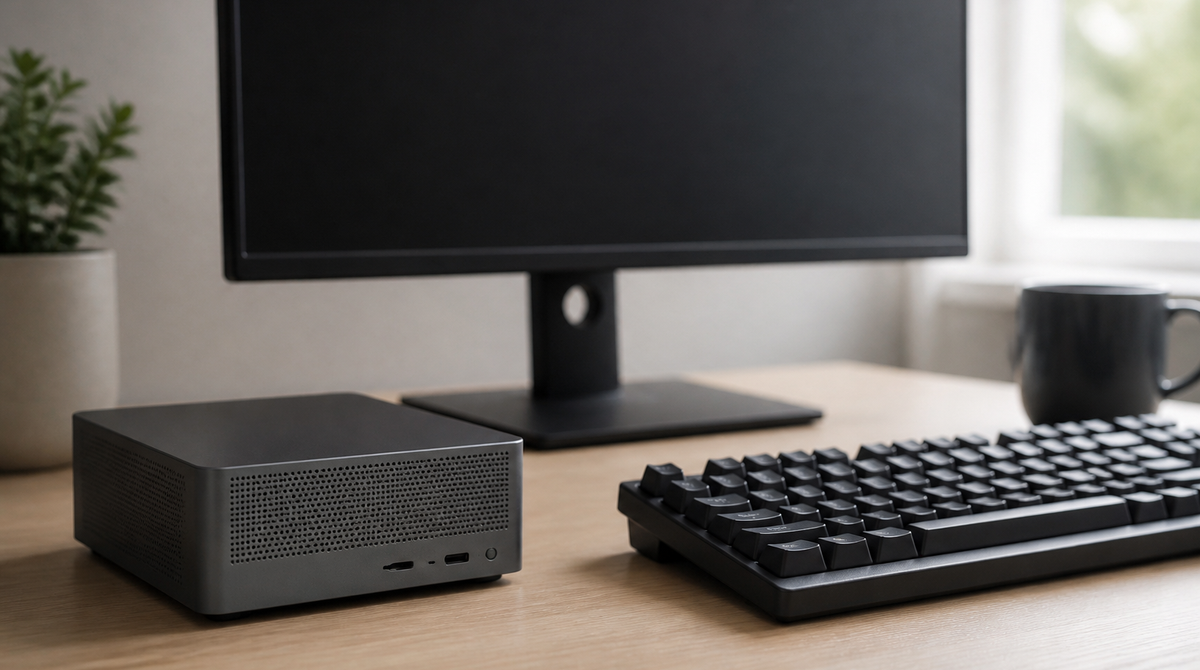
Microsoft announced Project Zenith on September 4 (US time), a program that ships a developer-tuned build of Windows 11 on a new class of PCs. It targets "developer-class" devices with at least 64GB of unified memory and 250GB/s or more of memory bandwidth. The pitch is twofold: the machine arrives with development tools and settings already in place, and it has enough headroom to run AI models with more than 30 billion parameters locally, without paying per-token cloud fees. The first supported device is AMD's compact Ryzen AI Halo, with more devices from OEM and silicon partners due in the coming months.
Finishing the setup work before the box is opened
Project Zenith boils down to two things: Windows 11 settings that are pre-adjusted for development, and the tools developers reach for first, already installed.
On the settings side, Windows Terminal and Visual Studio Code come pinned to the taskbar. File Explorer shows file extensions and hidden files, displays the full path in the title bar, and opens the details pane by default. Long-path support, which lifts the 260-character limit, is switched on. Elements that tend to pull attention away from work, such as the recently used files and folders list, tips from sync providers like OneDrive, Start menu tips, and account notifications, are turned off from the start. Command Palette from PowerToys is enabled in Search and Start, so the expected workflow is launching apps and commands from the keyboard.
For tools, Microsoft says the devices ship with a set spanning languages and runtimes, source control, and productivity utilities. Overseas reports name Visual Studio Code, GitHub Copilot, PowerToys, and WinAppCLI, the command-line tool for Windows app development, among them. The foundation is Windows Developer Configurations, which Microsoft made generally available at Build 2026. It uses WinGet's configuration feature to set up a development environment in one pass, and the MIT-licensed GitHub repository "WindowsDeveloperConfig" lists PowerShell 7, Git, GitHub CLI, VS Code, .NET SDK 10, Python 3.14 with uv, Node.js, PowerToys, and WSL with Ubuntu. Project Zenith effectively moves that step from something you run after purchase to something the manufacturer completes before shipping.
Logan Iyer, Microsoft's Corporate Vice President for Windows Platform + Developer, stresses that Project Zenith is not about prescribing a single workflow but about starting from a better baseline, and that developers can still rearrange the environment around their preferred languages and frameworks.
Why 64GB
The unusually high hardware bar of 64GB or more of unified memory and 250GB/s or more of bandwidth exists to run AI coding models locally. Microsoft envisions a split in which the hardest problems go to frontier models in the cloud while everyday agent workloads run on the desk, and it frames an environment that can run 30-billion-parameter-class models without token charges as a fix for "token economics." Agentic coding consumes compute continuously over long stretches, so shifting part of it to the client side is meant to lower cloud bills.
The first supported device, Ryzen AI Halo, is the developer-focused mini PC that AMD launched in the United States in July. It pairs the Ryzen AI Max+ 395 with 128GB of unified memory and was billed as capable of handling models up to 200 billion parameters locally. It was priced at 3,999 USD (about 620,000 yen) in the US, and sales in other regions including Japan were not announced at the time. AMD used its opening keynote at IFA 2026 to declare "the era of personal AI," presented Project Zenith as a collaboration with Microsoft, and showed a compact machine running the Zenith configuration on stage. Products built on the 192GB-capable Ryzen AI Max PRO 400 series announced in the same keynote are strong candidates for future support. According to overseas reports, Lenovo's ThinkCentre X Ultra, announced around the same time in a 1.6-liter chassis, features the Ryzen AI Max+ PRO 495 with up to 128GB of memory and is expected to ship in November starting at 3,699 USD (about 570,000 yen).
※1 USD = 155 JPY (as of September 4, 2026)
An OS built with agents in mind
The other pillar of Project Zenith is a secure foundation for developing and running AI agents. At Build 2026, Microsoft laid out plans to build OS-enforced identity for agents, containment through Microsoft Execution Containers (MXC), and enterprise-grade manageability into Windows. MXC enforces boundaries around the files and networks an agent is allowed to reach. Project Zenith devices are said to benefit from these investments from day one.
Linux integration is part of the base as well. Microsoft open-sourced WSL in 2025 and added WSL containers at Build 2026, giving Windows a built-in way to create and run Linux containers directly. On Project Zenith devices, these recent changes to Windows are available out of the box.
Not a universal welcome
Early reactions overseas mix approval of the direction with doubts about how narrow the target is. Demand for a distraction-free Windows has been loud for years, and the program is seen as an extension of the improvements Microsoft has been making this year to Windows 11 search, File Explorer, and memory usage. But with memory prices climbing sharply, requiring 64GB has drawn criticism that the machines are out of reach for individual developers. There is also a skeptical view that developers each carry their own configurations and will end up reworking the defaults no matter how carefully they are chosen.
That said, the configuration itself can be applied from the GitHub repository mentioned above, so getting close to the same environment without buying a Project Zenith device is possible. Microsoft has not yet disclosed pricing or the full device lineup, and how far the program spreads will depend heavily on what price range the devices beyond Ryzen AI Halo land in. Microsoft is also working in parallel on slimming Windows 11 for 8GB PCs, so it is now pushing at both ends of the spectrum, 8GB at the bottom and 64GB-plus at the top.
Summary
Project Zenith ships PCs with 64GB or more of unified memory and 250GB/s or more of memory bandwidth with a Windows 11 that already has developer settings and tools in place. Its goal is to run models above 30 billion parameters locally and reduce cloud token spending, starting with AMD's Ryzen AI Halo and expanding to other OEM devices in the coming months. It also folds in Build 2026 work such as the agent security platform and WSL containers, but pricing and device details remain unannounced, and concerns have surfaced about the program being limited to expensive hardware.