
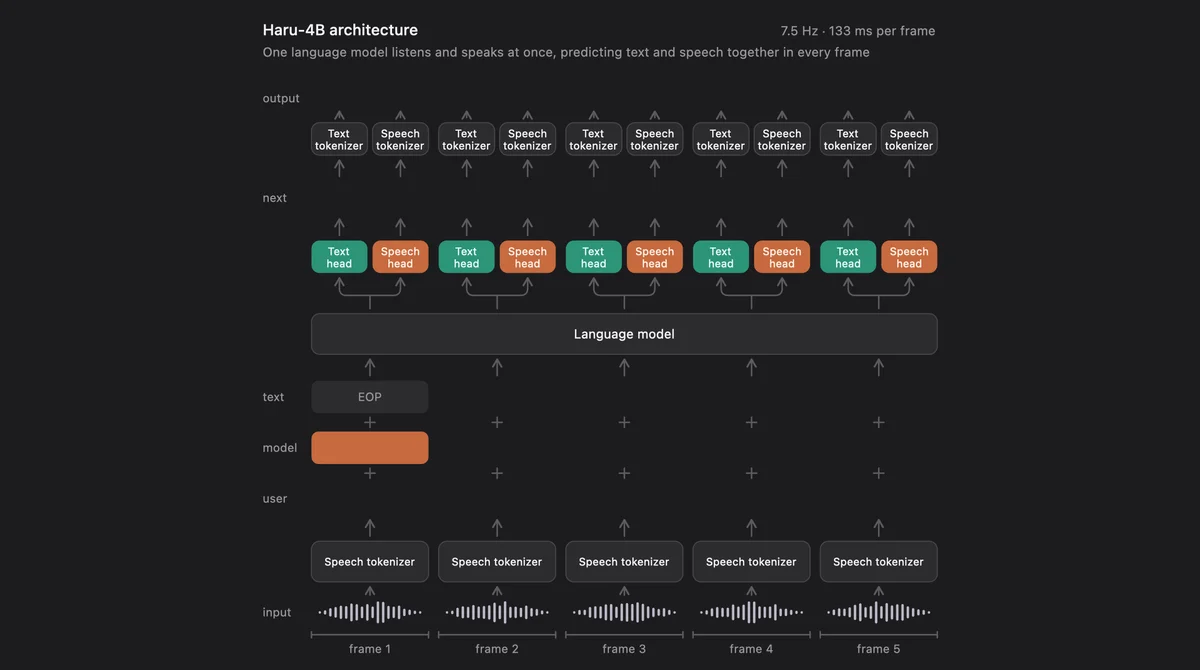
higurashi Inc., a Japanese company, has released Haru 4B, a full-duplex spoken dialogue model that can listen and speak at the same time. The weights of the pretrained 4-billion-parameter base model are available on Hugging Face, and the inference code is on GitHub, both free of charge under the Apache License 2.0. The Japanese tech outlet PC Watch reported the release on November 13.
It processes speech directly to handle backchannels and interruptions
Haru 4B is designed to do what people do in conversation: listen while talking. Most voice dialogue systems have used a cascade approach, transcribing speech with speech recognition, generating a reply with a large language model (LLM), and reading it aloud with speech synthesis, one step after another. Because processing begins only after the other person finishes speaking, such systems struggle to offer backchannel responses such as "uh-huh" or to react when they are interrupted mid-sentence.
According to higurashi's official page, Haru 4B does not split the work into these stages. It is an end-to-end model that handles audio directly and also learns when and how to respond. It treats three streams on the same timeline: the user's voice, the model's own voice, and text. These are merged roughly every 133 milliseconds (7.5 Hz) and processed by a single language model, which the company says lets it respond to backchannels and interruptions with low latency.
Built on Qwen3.5-4B, with support for nine languages
The Hugging Face model card says the text backbone is Qwen3.5-4B, and audio is encoded with the VibeVoice acoustic tokenizer, which represents speech as continuous values. Audio input and output run at 24 kHz.
Supported languages are Japanese, English, Chinese, Korean, Spanish, Portuguese, German, French, and Russian, nine in total. Users can also specify a character through text and set the voice from a reference audio clip.
It runs on a local GPU or a Mac
The inference code on GitHub includes a PyTorch implementation, a demo that runs in a web browser, and offline inference. It requires an NVIDIA GPU with about 12 GB of memory. The repository also provides an MLX implementation for Macs with Apple silicon, instructions for building a macOS app, and a plugin for the vLLM-Omni inference server.
Both the code and the model weights are licensed under the Apache License 2.0, which permits broad use, including commercial use.
It is a research base model, and should be used with care
What has been released is a pretrained base model intended for research. The model card notes that it "holds a natural conversation, but it is not a reliable source of facts and does not follow instructions the way an assistant does." higurashi's official page also points to the model's limited 4B size and cautions against expecting too much in terms of intelligence.
Because the model can imitate the voice in a reference clip, the model card asks users to "only use voices you have the right to use." Using someone else's voice without permission could lead to rights violations or impersonation.
higurashi says it will also work on developing larger models. Its official page announces a meetup to mark the release, planned for November 26 near Hongo-sanchome in Tokyo, Japan.
Our Take
Natural voice interaction with AI is an area many companies are pushing hard, but there are still few cases where the weights and inference code of a full-duplex spoken dialogue model are released under such a permissive license. Its multilingual support, including Japanese, and the fact that individuals can try it on an affordable GPU or a Mac should give researchers and developers a useful starting point for experimentation. On the other hand, as a base model its response quality has limits, and building it into a real service will likely require additional training and safety measures.
Summary
higurashi has released the weights and inference code of Haru 4B, a full-duplex spoken dialogue model that can listen while it speaks, under the Apache License 2.0. By handling audio directly and merging three streams roughly every 133 milliseconds, it responds to backchannels and interruptions with low latency. It is a research base model, so care is needed regarding factual accuracy and the handling of voices.