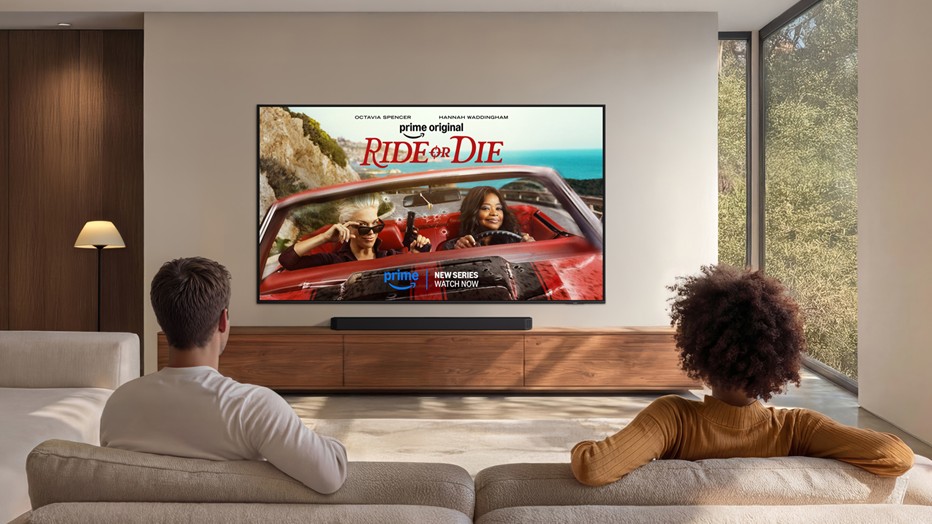
Samsung announced on August 4 that HDR10+ ADVANCED, the next version of the HDR10+ standard, will roll out globally on supported Prime Video titles during August 2026. The first devices able to receive it are Samsung's 2026 TV models. This is the first time the standard has been used for streaming, and Prime Video is the first service in the world to carry it.
Instructing brightness and motion from the content side
HDR10+ ADVANCED adds two things. The first is Enhanced Overall Brightness, which attaches broader statistical metadata to a title so a TV can actually use the headroom in its peak brightness. AI-driven tone mapping works alongside it, holding on to shadow detail in darker scenes while delivering the brightness that sports and action need.
The second, Intelligent Motion Smoothing, uses scene-by-scene metadata to switch how a TV handles motion. A film scene can keep its cinematic texture while a fast-moving sports sequence is rendered smoothly, and that choice is now specified by the content rather than picked by the viewer in a settings menu each time. It shifts the decision back toward the creator's intent.
HDR10+ was already a dynamic metadata format that carries brightness information scene by scene. ADVANCED is best understood as an extension that spells out how a TV should spend the extra capability it has gained.
Why the standard needed rewriting
The reason for the update is that TVs themselves have changed over the past few years. Screens have grown larger, peak brightness has climbed, and both color depth and processing power have improved. The metadata in the original HDR10+ was never designed with that much headroom in mind, so the better the panel, the more of it goes unused.
Taeyong Son, Executive Vice President of Samsung's Visual Display business, said that as home viewing options diversify, viewers place more weight on picture quality and immersion. BA Winston, Vice President of Technology at Prime Video, pointed to the way picture processing that follows each scene brings out more of the detail in a title.
The two companies have done this before. In December 2017, Prime Video became the first streaming service to support HDR10+, opening its HDR library to Samsung's 2017 UHD TV lineup. Close to nine years later, the same pairing is first out of the gate again.
A timing gap with Dolby Vision 2
Dolby Vision 2 is also aimed at 2026 televisions. So far only Hisense, TCL and Philips have committed to it, and all of them require a post-launch software update. Hisense expects its update as early as the end of the second quarter or the third quarter, while TCL and Philips point to around the fourth quarter. On the content side, Peacock and Canal+ are the names announced so far.
If HDR10+ ADVANCED starts appearing in actual streaming titles in August, it will at least reach a watchable state first. That said, with compatible hardware limited to Samsung's 2026 models, the contest over scale is only beginning.
No extra cost, but there are conditions
HDR10+ is a royalty-free standard co-founded by Samsung and Panasonic. According to HDR10+ Technologies, which governs it, the standard now has 183 adopter companies and more than 22,000 certified products. HDR10+ ADVANCED carries no royalty fees for either compatible content or compatible displays. Keeping licensing costs out of the retail price is a strong argument when the goal is broad adoption.
There are limits, though. HDR10+ ADVANCED does not apply when Filmmaker Mode is switched on, because a mode built to present the creator's intent untouched and a system built to spend a TV's extra capability are pulling in opposite directions. Samsung also says support begins with 2026 models and will extend to future products, without suggesting that existing TVs will catch up through an update. Whether you can try it at home is likely to depend on when you replace your set.
Summary
HDR10+ ADVANCED lets a title specify in detail how brightness and motion should be handled, with Prime Video as the first streaming service to carry it and Samsung's 2026 TVs as the first hardware to receive it. Being royalty-free, the standard has room to spread. For now, however, the experience is confined to Samsung's newest models paired with supported Prime Video titles, and it cannot be combined with Filmmaker Mode. Who leads the next generation of HDR will come down to how quickly compatible TVs and compatible titles multiply from here.