Google has revealed that it used many of the AI tools it announced at its developer event, Google I/O 2026, to produce the event itself[1]. From a short film and the visual brand identity to playable games, an app for ordering coffee on the spot, speaker intro videos, and stickers, the same AI shown on stage was working behind the scenes[1].
"Using the AI we announced, right on the production floor"
This year, Google set itself the challenge of out-doing its own team using the very same AI it was putting on stage[1]. With AI tools improving month after month and rewriting what is possible to create, the aim was to demonstrate a way of working that draws out human creativity while offloading mundane tasks to AI, freeing people to focus on what only they can do[1]. When the result is good enough, the audience stops thinking about where AI was used, and Google says that is exactly the shift it wants to share[1].
A short film born from cardboard and markers
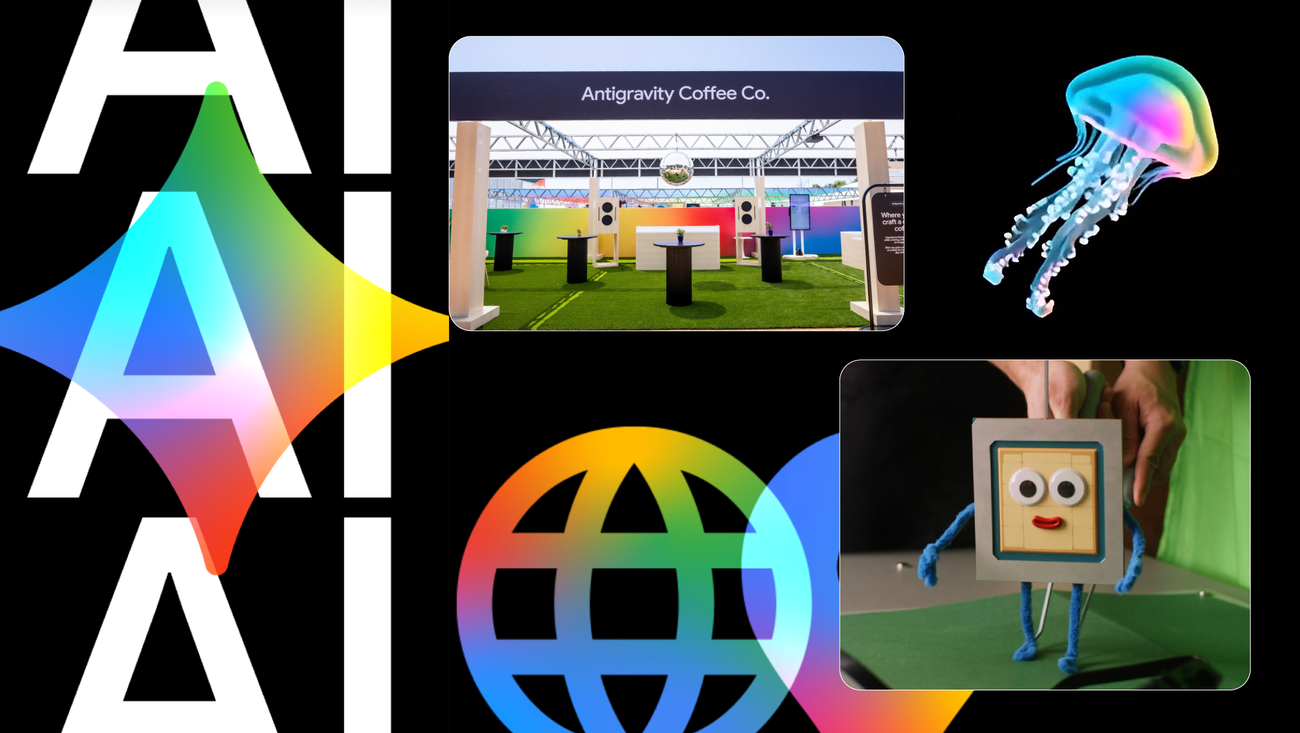
A symbolic example is "TPU Training Day" (nicknamed "Timmy TPU"), a short film starring the TPUs (Tensor Processing Units) hard at work for I/O[1]. The team worked with director Laurie Rowan and Nexus Studios, blending puppets, traditional animation, and AI[1]. They first captured the character performances and camera work with puppetry and simple 3D animation, then used the image-generation model Nano Banana to produce stylized first frames from that footage[1]. To keep the frames consistent, they built a custom tool inside Google AI Studio and tested for pixel-perfect matches at scale before the final generation[1]. Finally, they merged the base animation with the stylized frames using the video-generation model Gemini Omni and other models, finishing it as a film while preserving the subtle, handmade imperfections[1].
Brand identity and on-site experiences, made with AI
The event's overall visuals were also a collaboration between the team and AI[1]. They fed Gemini past brand guidelines and five years of I/O recaps, iterated repeatedly with Nano Banana, and arrived at a four-color gradient with interlocking icons[1]. This was distilled into flat 2D icons that dynamically transform into three-dimensional 3D icons[1].
AI was woven into the pre-show as well[1]. In "Jellectronica," created with the Monterey Bay Aquarium, the movements of moon jellies were turned into music. A model tracking the jellyfish was trained in Google Colab and run on a Coral NPU, while the music-generation model Lyria 3 Pro and others produced the sound[1]. In "Infinite Scaler," a game that generates its levels as you play, Nano Banana created sprite images from player prompts, inferred depth, and mapped textures onto 3D space[1]. "Code the Countdown," in which creators around the world designed the numbers 1 to 10 and stitched them together with code, was also shown[1].
From a latte app to title cards and stickers
For attendees, Google prepared the "Antigravity Coffee Co." app, which let people order lattes with custom art[1]. Built with Flutter and generative UI, the screen changed in real time, with Firebase bridging the frontend to models like Nano Banana. Using the agentic coding of the development platform Google Antigravity, attendees could even build their own ordering apps on the spot[1].
Each speaker also got a custom-generated title card[1]. For Josh Woodward, who leads Google Labs and Google Gemini, a digital version of him rode the Chrome Dino and dunked a basketball[1]. The assets were made with Nano Banana Pro, and within Google Flow the team used the video-generation models Veo and Gemini Omni to reproduce even intricate sports movements[1]. There was also a sticker project: catch the falling prompts within 20 seconds and pick two, and Nano Banana fused them into an original design printed on the spot[1].
Summary
Behind Google I/O 2026, the very AI announced on stage, such as Nano Banana, Gemini Omni, Veo, Lyria, and Google Antigravity, was used across the entire process of film, design, music, games, and app development[1]. By letting AI handle the mundane work so that people can focus on the core of creativity, Google answered the question of what you can really do with AI, in the form of producing the event itself.
Source: https://blog.google/innovation-and-ai/technology/ai/io-2026-google-ai/