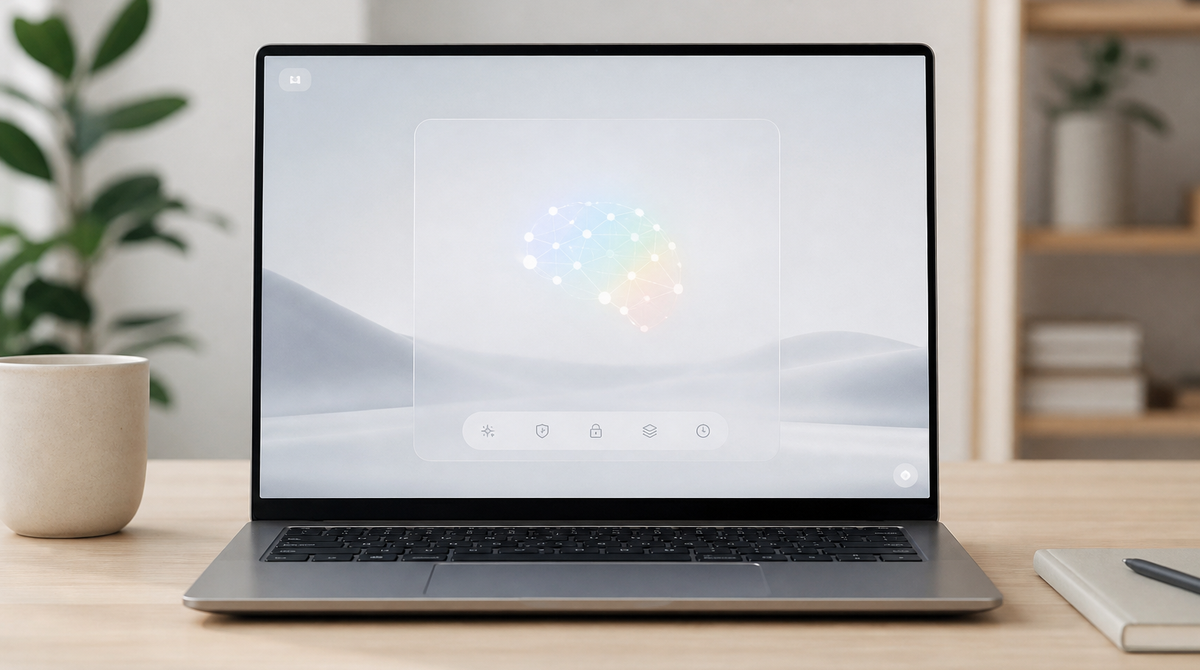
Google has released Gemma 4 12B, a new open model that runs on an ordinary laptop with no cloud connection required[1]. Despite its roughly 12 billion parameters, it runs locally on machines with 16GB of memory and can natively handle images, audio, and video in addition to text. The model weights are released for free under the Apache 2.0 license, which should broaden the reach of private, on-device AI that keeps data off the cloud.
A lightweight open model that runs on a 16GB laptop
Gemma 4 12B arrived as one of the AI updates Google highlighted in June[1]. While Gemini handles Google's top-tier models on the cloud side, Gemma belongs to the lineage of open models that can run on-device without a network connection.
Its biggest selling point is that it runs on a typical laptop with around 16GB of memory, without a dedicated server or GPU[1]. The model is about 12 billion parameters (12B), which is compact compared with large cloud-only models[3]. Even so, it can perform advanced reasoning locally, making it practical for handling data that cannot leave an organization or for use in the field where connectivity is unreliable[1].
Distribution is open as well. The weights are published for free under the Apache 2.0 license and are available on Hugging Face and Kaggle[3]. The model works with standard runtimes such as vLLM and llama.cpp, and is already supported by easy local launchers like LM Studio and Ollama, making it simple for developers to integrate into their own environments[3].
An encoder-free "unified" architecture
The technical highlight of Gemma 4 12B is what Google calls a "unified," encoder-free design[2]. Conventional multimodal models typically process images and audio through dedicated conversion modules (encoders) before passing them to the core language model. Encoders add to memory and processing overhead, and tend to slow things down.
Gemma 4 12B skips this intermediate step and feeds audio waveforms and image data directly into the core language model[3]. This lets it handle text, images, audio, and video within a single framework. Google positions it as a mid-sized open model that can process audio and video without going through dedicated encoders[2][3].
It can also take in a large amount of information at once, with a context window of 256K tokens[3]. That is enough to hold lengthy meeting transcripts, large codebases, or bulky documents in working memory all at once—a wide range of material for a locally running model.
The goal: AI agents that run on your own device
Google describes Gemma 4 12B as a foundation for "smart AI agents that run on a laptop"[1]. By unifying vision and native voice processing into a single streamlined system, it aims to deliver advanced reasoning and privacy-preserving workflows on everyday hardware without sacrificing speed[1].
Behind this lies growing interest in on-device AI. Not sending processing to the cloud reduces the risk of sensitive information leaving the device and lowers communication and usage costs. Models that distribute open weights are easy for companies and developers to build into their own setups for such uses, and Gemma 4 12B fits squarely into that trend.
That said, the performance and features described here are, for now, largely based on Google's own statements. Real-world usability and accuracy will settle as third-party verification and benchmarks accumulate. Since one advantage of open models is that anyone can try them locally, hands-on measurements and comparisons after release will be the next focus.
Summary
Gemma 4 12B is an open model of about 12 billion parameters that runs even on a laptop with 16GB of memory, released for free under the Apache 2.0 license. Thanks to its encoder-free unified architecture, it handles not just text but images, audio, and video within a single framework, and supports a wide 256K-token context. Whether it takes hold as a foundation for cloud-free, on-device AI agents among developers and privacy-conscious users will be worth watching.
出典:https://blog.google/innovation-and-ai/technology/ai/google-ai-updates-june-2026/
出典:https://blog.google/innovation-and-ai/technology/developers-tools/introducing-gemma-4-12b/