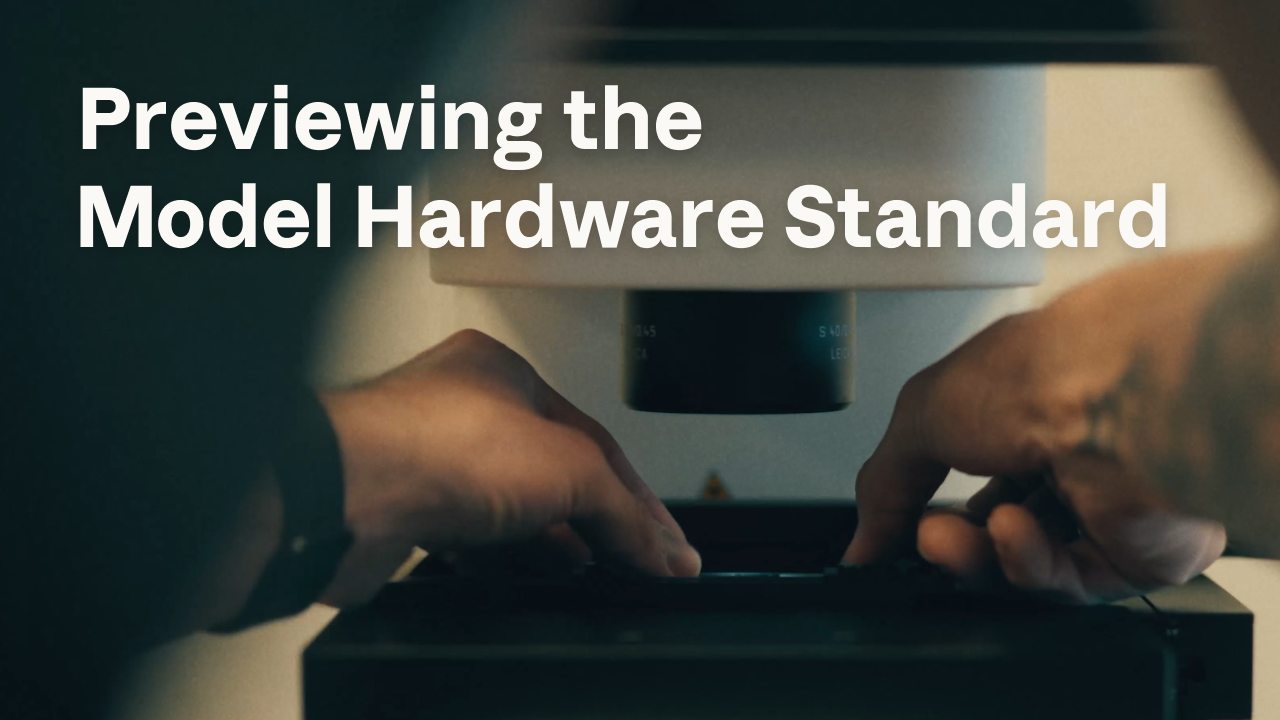
On August 27, 2026, Anthropic opened a research preview of the Model Hardware Standard (MHS), a shared specification that lets AI agents safely operate physical devices. Access is limited at first to a group of scientific research labs and advanced manufacturers, and the standard is set to be open sourced later. The idea is that a single agent can handle microscopes, liquid handlers, and robotic arms together[1].
Cutting device integration from weeks to hours
Wiring several instruments together in a lab or on a factory floor usually takes weeks, sometimes months. Each device has its own programming interface, so engineers have had to write bespoke translation code every time. MHS is said to reduce that integration work to hours, and in some cases minutes[1].
MHS began as a collaboration between Anthropic and HHMI Janelia Research Campus. The intended uses range from routine drug discovery experiments to laser calibration inside a quantum computer. Any device with a programmable interface qualifies, and the specification is explicitly model-agnostic. Any agent harness can reach it through standard protocols such as the Model Context Protocol (MCP)[1].
Talking to machines with just read and write
At its core, MHS is a standardized driver: software that translates between a computer's operating system and a hardware device. It works through a small set of primitives, a read such as get temperature and a write such as set temperature. Devices also become discoverable in a standard format, so agents and instruments can find each other across a network[1].
The interesting part is how MHS handles information that code alone cannot convey. The weight of a robotic arm, for instance, matters for moving it safely, yet that detail has typically lived in a paper manual or in someone's head. The MHS driver provides tags where this can be written in plain natural language, either by the user directly or by letting an agent interview them about the setup. From those tags, the driver automatically produces a reference file describing what the device can measure, what can be adjusted, and which safety limits apply[1].
There are three ways to control hardware: MCP, the command line interface, and code files (APIs). Combined, they let a single line of code orchestrate a sequence across multiple instruments. For long-running tasks, or when things need to move faster than an agent can reason step by step, driver commands from several devices can be chained into code files that the hardware executes on its own[1].
Anthropic describes Claude behaving much like a scientist during testing. It adjusted a laser, checked the result through a camera, and repeated the cycle, then packaged what it had learned into a deterministic script so the beam could be aligned with a single command[1].
Early numbers from the field
Launch partners have shared concrete results. Genentech implemented a proof-of-concept automating the BCA protein assay, which measures total protein concentration and requires coordination across a liquid handler, a robotic arm, and a plate reader. At Carnegie Mellon University, researchers had an agent orchestrate incompatible instruments spread across three computers and ran serial dilution dose-response experiments about three times faster than before[1].
The clearest result may come from QuEra Computing, which builds quantum computers from neutral atoms. When the lasers lost their lock, the ultra-precise frequency they must hold, a controller developed by the agent restored it 99.3 percent of the time without human intervention. At the University of Washington, a PhD student built an agent-supervised qPCR that watches amplification curves and halts the run at the right moment. At HHMI Janelia, a rig that previously required seven separate vendor programs was unified behind one interface[1].
Hardware vendors are moving as well. Amazon Web Services will support MHS through Strands Robots, its library for connecting AI agents to physical devices. Doosan Robotics, Universal Robots, Tecan, QIAGEN, MBF Bioscience, Automata, and Danaher are building or testing integrations, while Hugging Face is adding MHS support to its LeRobot robotics library and Raspberry Pi is enabling it across a number of its products[1].
The limits are stated plainly
Anthropic also lists what MHS cannot do. Because Claude learns about the physical world through text and images, its spatial and physical reasoning has limits, and expert oversight is still required. In the Genentech work, researchers had to guide Claude to recognize that errors caused by foaming in samples were physical failures rather than software bugs[1].
Hardware without a programmable interface falls outside MHS entirely, and Anthropic says it is working with those manufacturers to build drivers in. The company plans to use the research preview to develop safety evaluations before open sourcing the standard, and is building a physical safety roadmap to strengthen protections against misuse. Findings from the preview will be published alongside the open source release[1].
Summary
Anthropic has released MHS, a shared specification for letting AI agents operate laboratory and manufacturing equipment, as a research preview. A standardized driver abstracts devices behind simple read and write primitives, cutting integration work that used to take weeks down to hours. Early results come from Genentech, quantum computing company QuEra, and others, and Amazon Web Services along with several robotics makers have committed to support. Physical reasoning remains a real limitation, but the path for agents to move beyond the browser and the desktop is now taking shape as a specification.
Source: https://www.anthropic.com/news/model-hardware-standard-research-preview