Anthropic has released Claude Science, a new AI workbench for scientific research, in beta[1]. It is an app that handles everything from literature review and data analysis to creating figures and manuscripts in a single environment, and every artifact it produces carries a full record of how it was made, so the work can be validated and reproduced later. It is available today on macOS and Linux for Claude Pro, Max, Team, and Enterprise subscribers[1]. Rather than a new model, the notable point is that it incorporates the researcher's actual workflow itself[2].
Bringing Scattered Research Tools Into One Environment
In research, work routinely spans dozens of databases, file formats that require bespoke handling, and a roster of separate tools such as PubMed, Jupyter, R, and cluster terminals[1]. Claude Science brings these fragmented tools into a single research environment, letting scientists move through literature analysis, multistep analysis, and the creation of figures and manuscripts all in one place[1].
Users interact with a generalist coordinating agent. This agent can draw on more than 60 curated skills and connectors preconfigured for fields such as genomics, single-cell analysis, proteomics, structural biology, and cheminformatics[1]. The agent can spin up other agents as needed and works alongside specialist agents created by the user. A separate reviewer agent checks citations and calculations, flagging and correcting errors as it goes[1].
Reproducible Outputs and Compute Managed for You
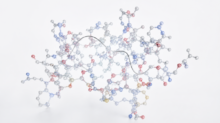
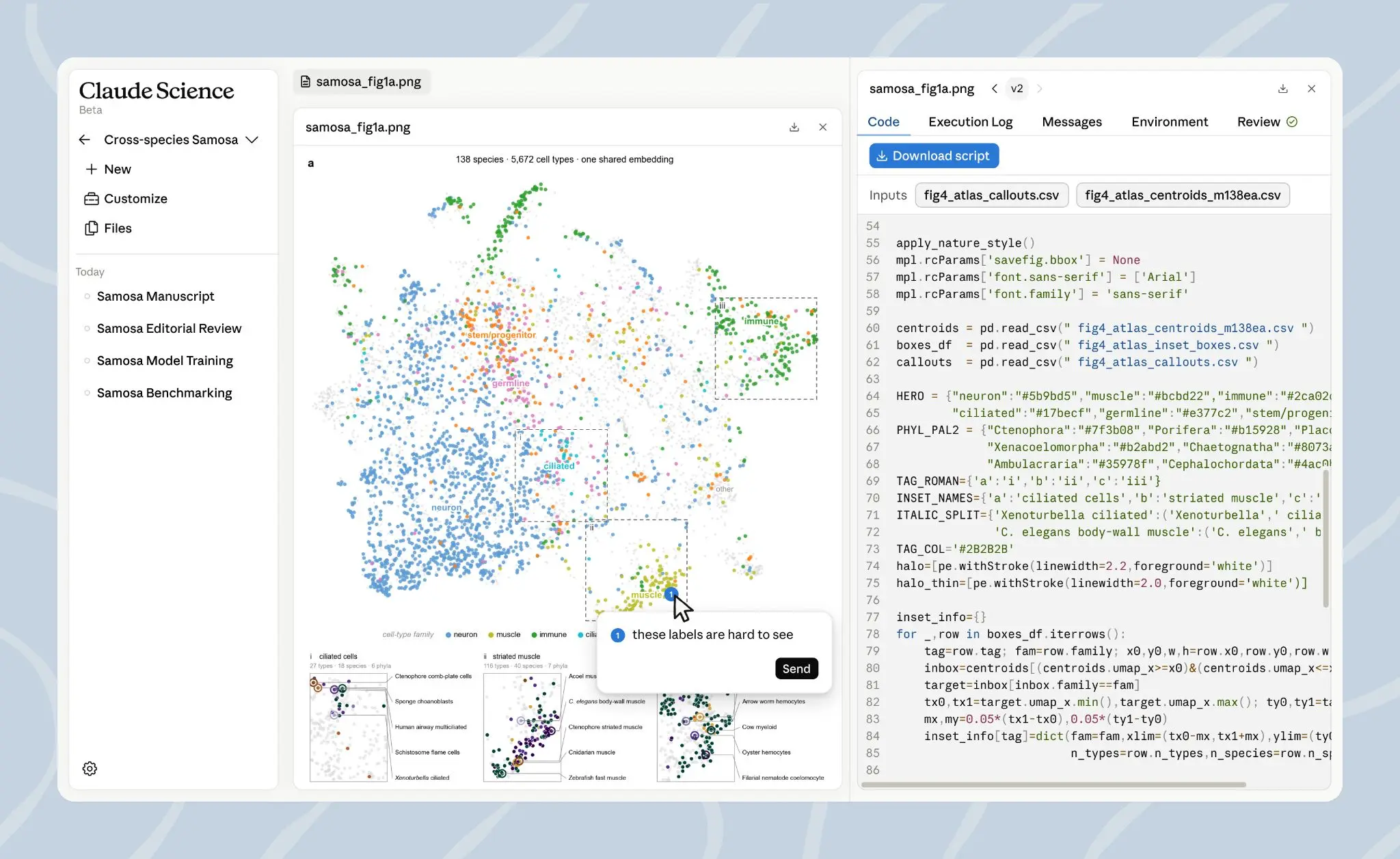
Because scientific research is inherently visual, Claude Science generates figures and manuscripts together with the code that produced them[1]. It natively renders 3D protein structures, genome browser tracks, chemical structures, and more, and when it creates a figure it includes the exact code and runtime environment used, a plain-language description, and the full message history[1]. This makes it possible to understand the inputs even months later, and to validate and reproduce the work. When you give an instruction in plain language, such as "remove the gridlines" or "set the axis to a log scale," the agent edits its own code to revise the figure[1].
The agent also manages the compute for large analyses[1]. For tasks that normally involve setting up jobs, waiting, and checking whether they succeeded, such as protein folding or genomics pipelines over massive datasets, Claude Science first drafts a plan, asks before connecting to new resources, and then submits the job to the infrastructure the lab already uses, whether an in-house HPC cluster over SSH or a Modal account for on-demand compute[1]. Analyses scale from a single GPU to hundreds as needed. Data stays on the lab's own systems, and only the context required at each step is sent to Claude[1]. You can also fork a session midway to compare two approaches without losing the original thread[1].
Domain-Ready From Day One, With NVIDIA's Toolkit Integrated
Scientific knowledge is scattered across hundreds of specialized sources. In biology, for example, data sits across resources such as UniProt, PDB, Ensembl, Reactome, ClinVar, ChEMBL, and GEO, each with its own schema and query language[1]. With Claude Science, when you ask a question in plain language, specialist agents query and synthesize across all of them[1].
For the life sciences, it uses NVIDIA's BioNeMo Agent Toolkit to connect directly to models and libraries such as Evo 2, Boltz-2, and OpenFold3[1]. It can also connect to the models, datasets, and pipelines a researcher already trusts, and any workflow saved as a reusable skill is automatically inherited by future sessions[1].
How Researchers Are Using It
Over several months of beta use, researchers have used Claude Science for tasks such as single-cell RNA sequencing analysis, CRISPR screen design, and protein structure prediction[1].
Manifold Bio, which designs tissue-targeting medicines, used Claude Science to nominate the targets for its latest experiments[1]. For each tissue and target, it assessed surface expression, in-body trafficking, and safety, ranking candidates against the criteria the company has learned from its own data. What set it apart from a general coding assistant, the company said, was that it could handle everything from gathering the right data to applying judgment end to end[1].
Jérôme Lecoq, a neuroscientist at the Allen Institute, built a system of about 20 custom skills in Claude Science for writing long-form review articles[1]. Sub-agents pull the central claim and key quantitative findings from thousands of papers and store them in an evidence database, then delegate each section to a dedicated agent. A review that previously took as long as two years was greatly shortened, and he has now completed about 10, some more than 100 pages long[1].
Stephen Francis, an associate professor and epidemiologist at the UCSF Brain Tumor Center, applied Claude Science to the molecular epidemiology of glioma and was able to run comprehensive analyses in roughly one-tenth of the previous time[1]. His group independently validated the results, confirming that the analyses were both fast and robust[1].
Availability and a Research Support Program
The Claude Science app is in beta on macOS and Linux for the Pro, Max, Team, and Enterprise plans[1]. Team and Enterprise require an administrator to enable it. Anthropic has also introduced a plan offering discounted seats for active labs at academic institutions and nonprofit research organizations[1].
In addition, the company will support up to 50 "AI for Science" projects, providing up to 30,000 USD (about 4.9 million yen) in credits per project[1]. Modal will also provide up to 2,000 USD (about 320,000 yen) in compute for selected projects. Applications are open through July 15, 2026, with award notifications by July 31, and projects will run from September 1 to December 1, 2026[1].
※1 USD = 162 JPY (as of June 30, 2026)
Summary
Claude Science is an attempt not to sell a new model but to bundle the tools and compute researchers move between every day into one environment, and to take in their workflow itself along with it[2]. It runs literature review, analysis, and the creation of figures and manuscripts in one place, attaches code, runtime environment, and history to its outputs to ensure reproducibility, and uses a reviewer agent to check citations and calculations. Its integration with NVIDIA's BioNeMo Agent Toolkit and more than 60 specialized databases, along with a design that runs on the lab's own infrastructure, shows a commitment to engaging with real research. That said, availability is currently limited to a macOS and Linux beta, and how useful it proves to be in each specialized field remains to be tested through real-world use in individual labs.
Source:https://www.anthropic.com/news/claude-science-ai-workbench