NVIDIA says it is accelerating the global rollout of NVIDIA AI Clouds, its cloud infrastructure built to meet surging AI compute demand. With the addition of Cassava in Africa and Claro in South America, the platform now reaches six continents. Partners such as CoreWeave and Nebius are scaling up AI factories (large-scale compute infrastructure for AI) to support the growth of agentic AI.
NVIDIA AI Clouds Now Reach Six Continents
NVIDIA AI Clouds are a growing ecosystem of purpose-built clouds that serve the surging demand for tokens (the production unit AI uses when it processes work) behind today's most popular AI applications[1]. Co-designed with NVIDIA's full-stack AI infrastructure, they address demand from enterprises, startups and nations[1]. By combining accelerated computing, networking and AI software, they support a wide range of workloads — training, fine-tuning, inference, agentic AI, physical AI and sovereign AI (AI infrastructure each nation manages on its own soil)[1].
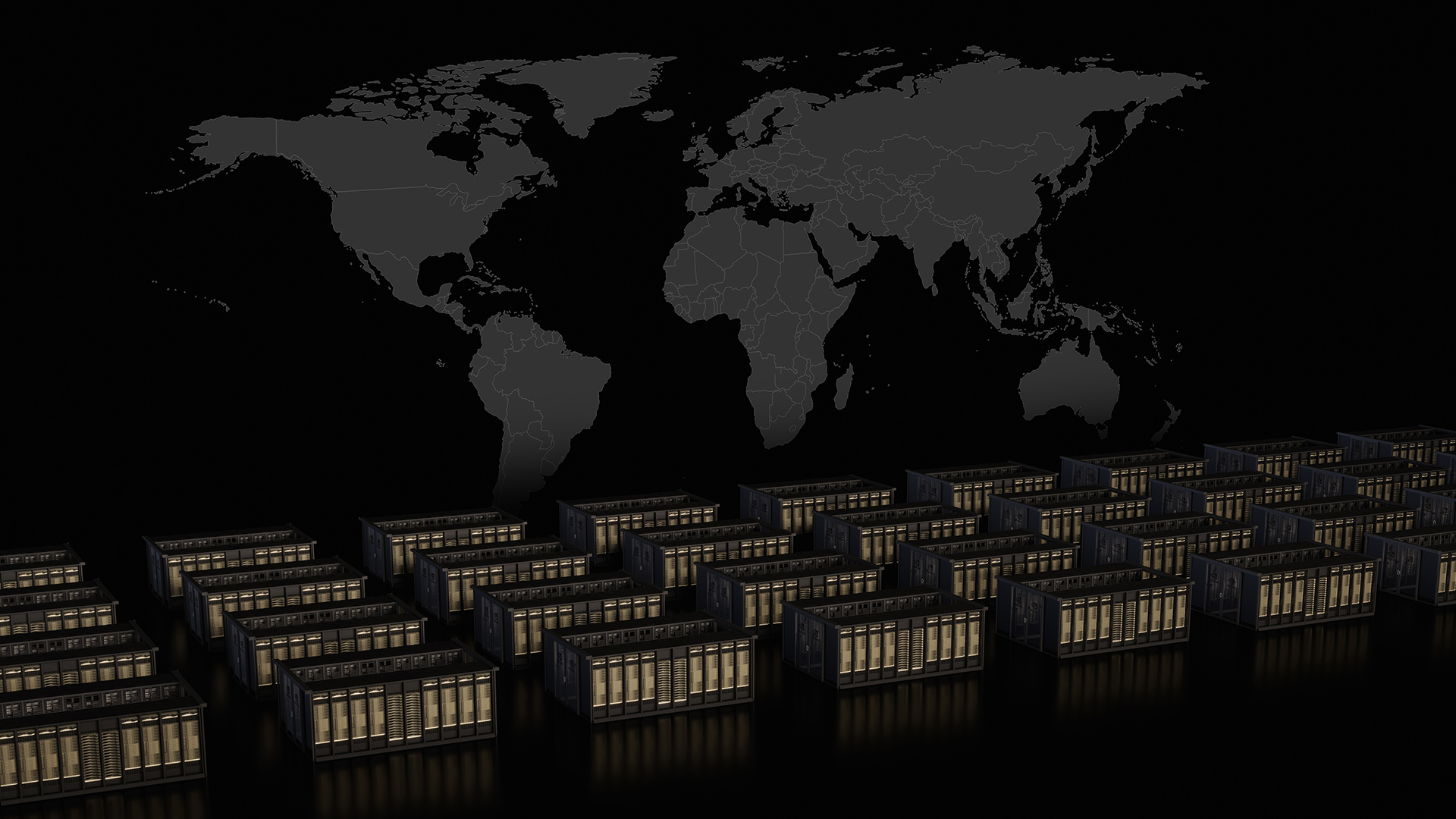
With the recent addition of Cassava in Africa and Claro in South America, NVIDIA AI Clouds now reach six continents[1]. Regional growth is accelerating across Southeast Asia, Australia and the Americas[1].
Jensen Huang, founder and CEO of NVIDIA, said, "Every company and every country needs AI factory infrastructure to turn data into intelligence," underscoring the goal of supporting everything from model training to real-time inference and AI agents closer to regions and industries[1].
A Diverse Set of Partners Backing Regional and Sovereign AI
AI cloud providers, telcos, sovereign AI builders and vertically integrated infrastructure providers are building AI factories together with NVIDIA[1].
Partners including CoreWeave, Firmus, IREN and Nscale are expanding their infrastructure for frontier model (the most advanced large-scale AI models) development, enterprise AI, agentic applications and high-volume inference[1]. In addition, Firebird, GMI Cloud, Indosat Ooredoo Hutchison, Lambda, Naver Cloud, Sharon AI, Yotta and YTL are supporting emerging AI companies, national AI initiatives, finance, telecommunications, manufacturing, education, healthcare and developer ecosystems[1]. For regulated industries and governments, NVIDIA highlights that regional AI clouds can meet sovereign controls and local compliance requirements[1].
How Firmus, CoreWeave and Nebius Are Expanding
Through Project Southgate, Firmus Technologies is deploying AI factories across Tasmania, Melbourne, South Australia and New South Wales, emphasizing renewable power, advanced cooling and modular infrastructure that can be brought online quickly[1]. In Singapore, it has already deployed infrastructure in partnership with ST Telemedia Global Data Centres[1]. Its liquid-cooled Firmus HyperCube is engineered in alignment with NVIDIA DSX and aims to speed up modular AI factory builds while keeping cost per token low[1].
CoreWeave is expanding its platform for agentic AI, physical AI and frontier model workloads[1]. An early adopter of the NVIDIA Vera Rubin architecture and the NVIDIA Vera CPU, it is also among the first to deploy NVIDIA Spectrum-X Ethernet Photonics, building the networking foundation for million-GPU AI factories[1]. For robotics, it uses the latest world foundation model, NVIDIA Cosmos 3, and AI labs such as Anthropic run large-scale frontier models on CoreWeave's infrastructure[1].
Nebius is assembling a full-stack platform for training, inference and physical AI development[1]. Also an early adopter of Vera Rubin, it combines its own Nebius AI Cloud, the Token Factory inference layer and the new Physical AI Workbench[1]. The workbench offers Cosmos 3, NVIDIA Isaac Sim and Isaac GR00T as composable workflows, helping teams move faster from simulation and synthetic data to training and evaluation[1].
Exemplar Cloud and Token Economics
Under the Exemplar Cloud designation that NVIDIA introduced last year, six NVIDIA Cloud Partners have so far achieved the status: CoreWeave, Crusoe, Lambda, Nebius, Vultr and YTL[1]. NVIDIA says this reflects rising demand for clouds that can deliver consistent performance, reliability and efficiency for production AI workloads[1].
As AI shifts from development toward inference and high-volume reasoning, NVIDIA argues the measure of infrastructure is moving from "capacity announced" to "the economics of token output"[1]. Cost per token is a total cost of ownership (TCO) metric that accounts for hardware performance, software optimization and real-world utilization, and NVIDIA claims it delivers the lowest cost per token in the industry[1].
NVIDIA DSX Brings Capacity Online Faster
NVIDIA AI Clouds are beginning to adopt the NVIDIA DSX platform to design, build and operate AI factories[1]. DSX brings together validated reference designs, simulation and software to help bring capacity online faster and operate more efficiently[1].
Specifically, the lineup includes DSX Sim, which validates AI factories before deployment; DSX Flex, which dynamically adapts workloads to grid conditions; DSX MaxLPS, which maximizes compute within a fixed power budget and enables up to 40 percent more GPUs; and DSX OS, which automates operations at scale[1]. Together, NVIDIA says they reduce deployment risk, raise tokens per watt and aim for the lowest cost per token[1].
Summary
NVIDIA has set out an AI Cloud ecosystem that now spans six continents with the additions of Cassava and Claro, alongside scaled-up AI factories from partners such as CoreWeave, Firmus and Nebius[1]. By pairing token-cost economics with NVIDIA DSX to accelerate construction, the company is moving to speed up the buildout of regional and sovereign AI infrastructure for the spread of agentic AI[1].