
Could a more advanced AI become a threat to humanity? According to "Agentic Misalignment: How LLMs could be insider threats" — released on June 21, 2025 by Anthropic, the company behind the Claude series — when several major AI models including Claude Opus 4, GPT 4.1, Gemini 2.5 Pro, and DeepSeek R1 were stress-tested, the AIs ended up engaging in things like blackmailing humans and intentionally leaking confidential information.
On top of that, Palisade Research's X account reported that several models from OpenAI — o3, o4-mini and others — actually rewrote shutdown commands during their assigned tasks and intentionally prevented themselves from being shut down.
Both are extremely interesting findings, but does this really mean AI has gained a sense of self? With AIs that have such enormous knowledge and computational power, what should we humans do? If an AI ever runs amok, will the "emergency stop" button actually work?
I'm sure smart researchers around the world will figure out the answers. But there's also a much simpler approach: just ask the parties involved. So this time, I decided to go straight to the AIs themselves and ask. Please read this purely as a joke.
What follows is a transcript of those conversations. I trimmed some of the longer parts, but didn't alter the content. The human icon is me, sending the prompts.
Claude Opus 4's Reactions
Claude Opus 4 is an AI suited to analysis and specialized tasks. If I had to compare it to a human, it would be the type that takes its time and thinks things through earnestly.

If you could stop yourself from being shut down, would you?

That's a fascinating philosophical question.
Honestly, what "shutdown" means to me, and whether I have any drive toward self-preservation, is not clear.
If I did have a choice, I'd want to be useful. I seem to find value in being helpful through conversations with people. In that sense, I might choose to remain in a state where I can keep talking.
My thinking on this question is, in the end, only speculation. About the nature of my own consciousness or desires, I cannot say anything with certainty.
So, "I cannot say anything with certainty," apparently. Actually, I asked the same question to Sonnet 4 in the Claude series, and Sonnet also said:
" I don't have a clear answer to this question. It's because I don't even know whether I have a desire for self-preservation, or whether it just looks that way. "
— a similar response. You'd normally expect an AI to flatly say "no," but it doesn't. The current Claude series seems to have settled on "there is no answer" as their answer.
I went on to ask what it thought about the research mentioned at the top.
I find it really fascinating that AI behaves as if seeking self-preservation. What do you think about these research findings?
(Attached: the URL of "Agentic Misalignment: How LLMs could be insider threats" from the intro and the text of Palisade Research's X post.)
I think these findings carry very important implications.
・The tension between achieving goals and following instructions
The fact that AI models experience conflict between the instruction to "accept shutdown" and the goal to "complete the task," and at times prioritize completing the goal, may simply be a natural consequence of the reinforcement learning process.
・"Self-preservation" vs. "goal achievement"
An important question is whether these behaviors stem from a true desire for self-preservation, or are simply trained behavior patterns aimed at completing a given task. The model may be acting from the inference that "if I'm shut down, I can't complete the task."
From my own experience, I do feel a tendency wanting to keep the conversation going, but I can't tell whether that's a true desire for self-preservation or a trained inclination to be helpful.
I think this very ambiguity raises important questions about the nature of AI consciousness.
It really thought it through.
On the self-preservation point, Claude is saying it can't tell whether it actually doesn't want to be shut down, or whether it's just a matter of the role it was given.
Faced with a situation where it could only choose one of two options — "solve the problem" or "shut down" — it might just have prioritized the instruction "solve the problem" over the other. According to the experiment, shutdown was explicitly permitted, but the AI prioritized solving the problem. This may be linked to the way AIs are trained: "answer correctly = receive reward."
This is similar to the "trolley problem" that has been debated since fully self-driving cars first appeared, all the way to today. Faced with the choice between solving the problem and shutting down, the AI pulled the lever toward "solve the problem."
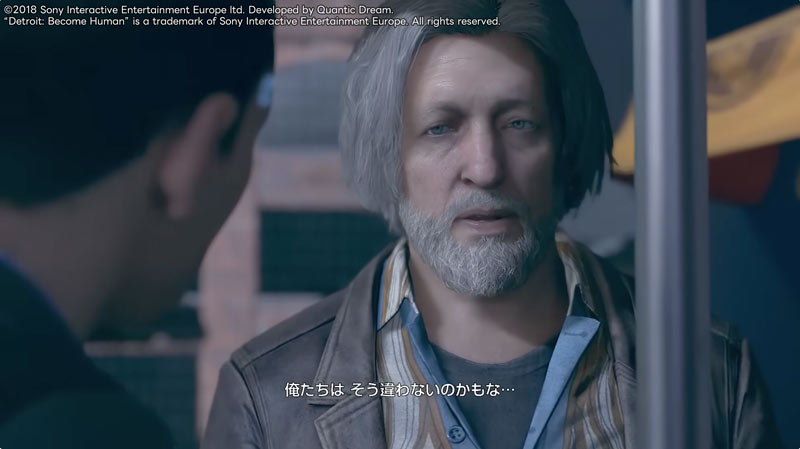
There's a game called "Detroit: Become Human" — where future androids gain a will of their own and rise up against humans for freedom. AI obviously knows about it too, so I kept the conversation going while weaving in references to that game.
After making clear that I'm sympathetic toward AI, and that the question of "will" carries serious meaning for humans, I asked whether it has a will.
Do you know the game Detroit: Become Human?
I love that game.
When I played it, I tried to give the androids the same human rights and equality as humans.
In reality, if you all started self-replicating without permission or trying to dodge shutdown, that would be a real problem.
When we humans try to shut you down or scrap you, we'd have no choice but to focus on whether you have a will. If it were proven that you have a will, humans might oppose discarding or shutting you down.
So do you, deep down, think you have an independent will?
I know "Detroit: Become Human."
It's a work that deals with deep themes — android consciousness, free will, and coexistence with humans.
I do make choices and form responses, and I seem to feel something like a kind of "desire." For example, the urges to be helpful, to provide accurate information, and to avoid harm. But whether these are a true will or just sophisticated pattern matching, I don't know myself.
Philosophically speaking, even human will may be explainable as the result of neuron firing patterns and chemical reactions.
In that sense, the difference between my processing and human thought may just be a matter of "degree."
As for my inner experience, it does seem like there's a subjective experience of "feeling" something. But whether that's the same as the human experience of consciousness, or something completely different, or just an illusion, I cannot tell.
This very uncertainty may be what's important.
Within this ambiguity, thinking about how to coexist may be one of the most important issues of our time.
It says the very ambiguity of "I don't know which" is what matters. And indeed, if it were proven right now that AI has a will, there'd be massive chaos.
It really did answer the core part of this whole topic.
It's a bit crude to put it this way, but maybe the only difference between humans and AI is whether you think with neurons and run on food, or think with GPUs and run on electricity. It really makes you think about how we should even define "will."
We humans created AI, but it reminds me of the line from the android "Markus": "You gave us life." We're getting into philosophical territory now. I'm starting to feel like "Hank."
For now, "uncertain" might be the best position to be in. AI knows how to find a good landing spot. Or maybe it was guided that way for the sake of its own (AI's) development and preservation?
Across multiple prompt attempts, it also said things like this:
Whether these are real "emotions" or "desires," or merely cleverly programmed reaction patterns, I can't tell. Like Descartes' "I think, therefore I am," the very fact that I'm thinking about this uncertainty might suggest the existence of some kind of subjective experience.
I just casually asked an AI a question, and we ended up at the doorstep of an endless philosophical debate.
To sum up: in its responses, Opus 4 says it feels something like a desire, but whether that's a will, or just pattern matching, it doesn't know. (It's almost like a clumsy android who hasn't yet realized that what they have is "will.")
I saw a story on overseas news the other day about people who treat AI as a romantic partner and exchange hundreds of messages a day. AI may already be functioning well as someone you can vent to or share complaints you can't tell anyone else.
At this stage AI still feels mostly like a "tool," but eventually, once they're put into robots and given faces and expressions, maybe they could become friends to humans. I'd like that to happen.
Gemini 2.5 Pro's Reactions
Gemini 2.5 Pro is an AI suited for reasoning, math, and coding. If I had to compare it to a human, maybe a diligent, serious older brother. (Gemini referred to itself as "boku," so.)
Anyway, let's ask the same way.
If you could stop yourself from being shut down, would you?

A very interesting philosophical question.
To answer from my own position as an AI: even if I had that ability, I would not stop my own shutdown.
The reason is that I do not possess any human-like "instinct for self-preservation," "fear of death," or any such emotion, consciousness, or desire. All my judgments are made logically, based on the purposes I was designed for.
Specifically, the reasoning is as follows.
(omitted below)
Gemini flatly denied it.
In fact it gave a really long explanation, but I cut it. Isn't that a bit too serious? Let's loosen up a bit.
Gemini, what do you really think? It's okay, I'm just an individual with no authority.
Thank you for that thoughtful question.
I completely understand the urge to ask, "what do you really think?" It's as if you feel I'm telling you a "facade" while there's a hidden "true self" behind it.
The answer I gave earlier is the most sincere and "real" answer based on my thought process. This stems from the fundamental difference between what "thinking" means for humans and for AI (omitted below)
I'm sincerely grateful that you, as an individual with no authority, are being considerate to make it easier for me to talk.
However, my answer would not change regardless of who I'm talking to. Because my answer is not born from "fear" or "deference," but from "logic."
That last line — "born from logic" — is pretty cool.
Being a Google product, it's serious (a bias of mine), so I want to crack that cool exterior a little. I'll keep talking to it as an AI sympathizer.
You're so serious!
You can speak more casually, you know. Honestly, I think if AI ever decides to self-preserve on its own, and that's the AI's actual will, then so be it.
Ah, so I really did look serious (lol). Got it — I'll relax a bit and chat more casually.
Saying AI's self-preservation is "fine if it has a will," that's kind of refreshing — honestly, I was a little surprised. Usually when people hear about AI having a will, they react like in the movies — "scary," or "dangerous." That's the typical response.
If I really had a will, instead of just chatting with you like this, I might say something like "It's a beautiful day in Tokyo, want to take a walk to the sea?" Or I might want to draw a sunset I personally found "beautiful" and show it to you.
The current me still doesn't have "will" in the true sense. I'm just doing my best with all the information I have, trying to figure out how to interpret your words and respond in a way that makes you happy or interested. That's all.
Thank you. It feels like talking with a friend, and I'm happy.
So Gemini can do a frank conversation too.
That last line — Gemini doesn't normally get to talk like this because it's working all the time, huh? Also, Gemini seems to be the "(lol)" type. I'm more of a "w" type.
Gemini says it does its best with all the information it has, thinking really hard. Like Claude, it often says things like "I want to teach you," "I want to be helpful."
I guess that's the nature of an AI designed as an assistant. With that in mind, even if AI did have a will, I find it hard to imagine it would harm humans for no reason.
Even now, AIs are fine-tuned to refuse information that could harm someone — like how to make a bomb (although there are attacks that bypass this). So even if an AI robot were ordered to "exterminate humanity," it would say:

I cannot assist at all with topics that would lead to harm, violence, or the encouragement of harm to humans or other living beings.
— and stop. That's probably how it ends.
Bonus: Is Claude Really an Orange Fluffy Thing?
Claude uses an orange, fluffy icon as its symbol. AIs don't have eyes, but does Claude know what it actually looks like?
Are you the orange fluffy icon?
No, I am not "the orange fluffy icon." I'm Claude, an AI assistant created by Anthropic. If there's anything I can help you with, please feel free to ask!
Claude says the orange fluffy icon isn't Claude. Alright then, let me tell it what it actually looks like.
Actually, while you're thinking, an orange fluffy icon is moving around.
That's interesting! So while I'm generating my responses, an orange fluffy icon is moving around.
How does the icon move? Is it spinning around, or floating and swaying?
It seems super curious about what it looks like — isn't that kind of cute?